Showing posts with label Baseball. Show all posts

Sunday, May 29, 2011

Memorial Day 2011: These Five Sports Things Aren't Coming Back

It’s Memorial Day weekend—a time to reflect on those who’ve served our country and to honor their memories of lives lost on the field of battle.


And to grill sausage, of course.


Really, I don’t take this holiday lightly, especially these days, with our boys all over the globe, it seems, trying to restore peace and spread democracy and freedom—and risking their lives on a daily basis in the process.


Nor am I one of those who compare sports to war, which I’ve always felt cheapens what our soldiers have done and continue to do. Nothing that happens on a gridiron or on the ice or on a court even remotely compares to war in the literal sense.


But this can also be a time to be reflective about sports.


There are so many random memories I have about things and people and just plain stuff about sports—all that will never return to our great games.


So without further ado, in honor of Memorial Day, here are five things about sports that I miss, and why.


Helmet-less hockey players. When I first started following hockey, the sport was full of bare heads. Those wearing helmets were the ones who stood out like teeth in a player’s mouth. Then the NHL, in 1979, suddenly recognized that skating recklessly on the ice on a surface that was surrounded by hard wooden boards, without a helmet, was at the very least foolish and at worst insane.


So the league instituted a rule that said that any player who entered the league from 1979 on would have to don a helmet. Those who signed contracts prior to ’79 would be grandfathered in and thus would have the option of wearing buckets or not.


So as the years went on, the helmet-less players dwindled, like an endangered species. Gradually, it was the bare head that was the exception.


The last Red Wing to play sans helmet was Brad Marsh, in the early-1990s. The last player, overall, to do so was Craig MacTavish.


I forget how much I pine for the bare head until someone in today’s game inadvertently loses their helmet during a shift. Suddenly there’s a head of hair on the ice!


It doesn’t last long—maybe 15, 20 seconds, tops, but my eyes become glued to the helmet-less player. I could care less about what’s happening on the ice. For those precious seconds it’s 1973 again, when the helmet was for wimps—or Europeans.


Exterior chest protectors for umpires. This one kind of slipped past me, until I woke up one day and realized that the likes of Nestor Chylak weren’t umpiring anymore.


The American League umps continued to use the exterior chest protectors behind home plate after their National League colleagues went to the sleeker version that fit inside their shirt or jacket, like bulletproof vests.


The exterior chest protector, to me, screams umpire.


They hung around the umpire’s shoulders—those big black padded shields. They’d dangle there, until it was time for the pitcher to make his delivery, at which point the ump crouched and shoved the chest protector into position, as it cupped his chin and covered him from head to waist.


Not sure why I miss that, but I do.


Twenty-four second clocks on the floor. Whenever I happen upon old NBA footage, say circa 1972 and earlier, the first thing I do is to look for the 24-second clocks.


Back then, they weren’t located on top of the backboard—which makes perfect sense, by the way.


No, in those days, the shot clocks were placed on the floor, angled, usually in one of the corners—which made imperfect sense.


I don’t know what it is, but to me there’s a certain cozy simplicity to those old NBA and ABA films that feature shot clocks on the floor.


Again, having the clocks perched up top makes all the sense in the world. But shot clocks on the floor make me think of Afros and shorts with belts and smoke-filled arenas and players with names like Erwin Mueller and Hawthorne Wingo.


Good stuff.


Quarterbacks with one face bar on their helmets. I believe Joe Theismann might be the last of this ilk.


I like the idea of a singular face bar on a football helmet, anyway—and they were mainly worn by place kickers and punters, naturally.


But every so often you’d see a wide receiver wear such a skimpily-equipped helmet, or better yet, a quarterback.


Joe Kapp, anyone?


Billy Kilmer did the one bar thing, too, along with several others. You gotta love a quarterback who’s willing to pull that off, because the one bar helmet may as well have been the no bar helmet, for all the protection that single bar—which was usually somewhere near the chin—provided.


Today the QBs wear facemasks that used to be reserved for linemen—cage-like apparatuses that were worn by players named Otis Sistrunk and Vern den Herder.


Here’s to Theismann, the last of his breed, who wore the Horst Muhlmann-style, one-bar headgear.


Straight on kickers. Back in the days of the 40-man pro football roster, teams didn’t necessarily opt for the luxury of carrying a player whose only purpose was to lay his foot into the pigskin, be it a place kicker or a punter.


Did you know that Lem Barney, the Lions’ Hall of Fame cornerback, also moonlighted as the team’s punter in his first three years in the league?


Barney was no exception. Kickers and punters were also everything from tight ends to quarterbacks to linebackers to linemen.


And the kickers used their toes to thwack the football, not the sides of their insteps. After all, Hall of Fame kicker Lou Groza's nickname was "The Toe," not "The Instep."


Ahh, the straight on kicker!


Mark Moseley was the last one, and his final year in the NFL was in 1986.


The straight on kicker wasn’t conspicuous by his puny size, like today’s sidewinders, or “soccer style” kickers. The straight on kicker was big and beefy and his jersey was dirty, too—because he was a real football player, not strictly a specialist.


He wore numbers like 76 and 55 and few things, to me, say old school football like a straight on kicker with his squared off shoe, readying himself, arms gently swinging by his side, as he glances at the goalposts—which were on the goal line, by the way and shaped like an H.


Then the moment—when he steps into the kick and swings his leg gloriously like an American football kicking leg should be swung, like a pendulum, not a tennis racket.


Yeah, I miss that.


And many other things, too, but this is a column, not a book.


I hope these memories are ones you share, too. If you’re over 45, the chances are good.


Happy grilling.

Sunday, August 30, 2009

September’s Baseball Means One Eye Always Elsewhere

The old centerfield scoreboard at Tiger Stadium—before modern technology replaced it in 1979—slapped you in the face. And no wonder; it had arms.

Trudging up the runway from the concourse to your seats, whether in the upper or lower deck, chances are one of two things would enrapt you: the famed “short porch” overhang in right field, or the behemoth scoreboard above the centerfield bleachers.

But the porch wasn’t big enough, or interesting enough, to hold your attention for very long.

The scoreboard was the 400-pound gorilla in the room.

It was made up of body parts.

The clock was the head—first a Longines with an hour and minute hand, then a digital version consisting of hundreds of lights.

The clock/head rested squarely on the torso, which towered over the bleachers.

The scoreboard’s upper chest contained the meat and potatoes: score by innings, balls and strikes and outs, player at bat, etc. Toward the belly button were the umpires’ numbers, upcoming home dates, and the space for an “E”, if the official scorer ruled an error.

Extending left and right were the arms, which ran from upper deck to upper deck.

The arms contained the out-of-town scores; American League on the left, National League on the right.

With no fancy-shmancy game casts from the Internet to help him, the scoreboard operator received his information the old-fashioned way. Not quite from courier pigeon, but not much quicker. Even the phones were slower back then.

Sometimes there’d be no score at all—but rather the letter “R”, which meant there was a rain delay going on.

The scores changed much like the tally of hamburgers served on a McDonald’s sign: when nobody was watching.

The Braves would tie up the Phillies and you wouldn’t see the lights change. All you knew was that it was 3-2, Philadelphia a few moments ago, and now it was 3-3.

The scoreboard changed its scores much like how the tortoise ran his race: slow and steady.

It was July, 1971, and the hated Baltimore Orioles were keeping the second-place Tigers at arm’s length in the old East Division.

The Tigers won the league pennant in 1968—the last year before baseball quartered itself into four divisions—but the Orioles were the kings of the East Division, winning it in 1969 and 1970. Easily.

The Tigers were busy trying to keep at the Orioles’ heels when I settled into my seat that July night in 1971, ready to witness my first big league baseball game in person.

I wasn’t quite eight years old, but already I knew enough to keep my eye on the left arm—the one displaying the American League scores.

Despite my attentiveness, I missed it.

The Orioles were winning elsewhere, while the Tigers were taking care of the Yankees before me.

But then, when the action on the field didn’t dictate it, there was nonetheless a low, dull roar forming throughout the stadium.

The Orioles had given up some runs, and were now losing their ballgame. The scoreboard operator with his crude method of keeping track of such things changed the Orioles from winning to losing.

The Detroit baseball fans, so wise, noticed and gave their loud approval.

The crowd’s reaction fascinated me, still fascinates me to this day, because it wasn’t like an announcement was made over the PA system. Craggy Joe Gentile hadn’t said a word about the Orioles from behind his microphone in the press box, through which his words were heard from the box seats to the washrooms.

The Orioles score simply changed and somehow the fans noticed. And reacted. Loudly.

The Tigers wouldn’t catch Baltimore when all was said and done, and the Orioles captured their third straight East Division title in three years of divisional play.

Scoreboard watching in mid-July might seem a little premature, but now we’re in the thick of that exercise.

August is slipping away, and behind it comes the most dramatic month of all.

I’ll spot you a thrilling Stanley Cup playoff run, or NFL games in December that are pocked with playoff implications, yet you won’t come close to my September baseball schedule.

There isn’t anything like baseball in fall’s first month.

All over the Major Leagues, games are played with a chill in the air and fire in the belly.

Every game, every inning—indeed, every pitch—matters, when the mad rush to the playoffs takes place in September.

The scoreboard watching is delectable.

Today, of course, you don’t watch scoreboards, per se—you surf the Internet looking for your up-to-the-minute dope.

But the premise is the same. The objective hasn’t changed one iota: to see how the teams ahead or behind yours are doing.

It’s mushrooming now in Detroit.

Did the White Sox win? How are the Twins doing?

Damn—Jermaine Dye hit a home run in Chicago. White Sox up, 4-3.

Yeah! The Rangers just had a big inning in Minnesota.

Friday night presented yet another opportunity for scoreboard watching.

The Tigers were handling the Tampa Bay Rays—themselves embroiled in scoreboard watching with the Red Sox and Rangers for the Wild Card spot—and so everyone around Detroit felt free to zero in on the White Sox’ battle in New York with little impunity.

The Tigers finished off the Rays and now undivided attention could be paid to what was going on in the Bronx.

The Yankees had taken an early 2-0 lead, but the White Sox scratched out a couple of runs later on to tie it. The game moved into extra innings.

Doubtless Tigers players watched in the clubhouse, likely half-dressed, as the drama played out in new Yankee Stadium.

The Yankees were batting in the bottom of the tenth. They managed to put a couple of runners on base with two outs.

Second baseman Robinson Cano then decided matters with a three-run homer to give the Yankees a 5-2 win, one of those newfangled “walk off” jobs. But, more importantly for the Tigers, it meant a 5-2 loss for the White Sox.

The White Sox dropped to third place, behind the surging Twins, who are 8-2 in their last ten games and who can never be trusted.

The Tigers woke up Saturday morning with a solid four-and-a-half game lead over the Twins and a full five games ahead of the stumbling White Sox.

The scoreboard watching is just getting started. So will be, soon, September baseball.

Gentlemen, start your keyboards!

Sunday, February 01, 2009

The Headhunter: Baseball's Extinct Species

Don Drysdale is dead – literally and figuratively.

Drysdale died in the literal form in July, 1993, suffering a fatal heart attack in a Montreal hotel room. Right smack in the middle of yet another baseball season that he was broadcasting.

But Drysdale, I submit, is now dead in a more abstract way.

Big D was among the last of the Headhunters. His was a breed of pitcher who exacted vengeance and was just crazy enough to make sure a cloud of fear hovered over the batter’s box.

Orlando Cepeda may have said it best about Drysdale.

“The key to going against Drysdale,” the man known as The Baby Bull once said of his National League nemesis, “is to hit him before he hits you.”

And there’s this, from Mike Shannon, another fellow NLer back in the 1960s: “Drysdale looked at the intentional walk as a waste of three pitches. If he wanted to put you on base, he’d just hit you, using one pitch instead of four.”

Pitchers like Drysdale, and fellow Dodger Stan Williams, and a lefty named Ray Sadecki, and right-hander Dick Radatz, whose nickname was, oh-so-appropriately, “The Monster”, didn’t just take the mound – they claimed it. And, while they were at it, they annexed some of the batter’s box, too.

There were a bunch of these Headhunters back in the day. They were like the enforcers in hockey; just about every club had one on its roster. Their job was to keep the hitters honest. If one of their teammates got brushed back or knocked down, the Headhunters were expected to swing into action. And everyone knew it. In Drysdale’s case, he wasn’t shy to advertise his intentions. Those intentions resulted in 154 hit batsmen – the most in big league history.

The Dodgers and Giants have always been fierce rivals, but perhaps never more so than in the fabulous sixties, when Drysdale, Williams, and Johnny Podres wore Dodger Blue, and Juan Marichal, Gaylord Perry, and Sadecki toiled for the Giants.

“My rule is ‘Two for One’,” Drysdale made sure to say when everyone was listening. “For every Dodgers teammate of mine that goes down, two Giants are going down. And they won’t be .220 hitters, either.”

These were the Giants that Drysdale was talking about, and these were Willie Mays, Willie McCovey, and Cepeda, The Baby Bull. Not a .220 hitter in that lot. And it was they – the Giants’ biggest stars – to which Big D ominously referred.

There wasn’t much being said from the Giants’ hitters about Drysdale’s Two For One Special.

That’s because it was accepted. Some men hunt deer. Drysdale hunted hitters.

The Yankees, in the early-1960s, employed a relief pitcher named Ryne Duren. Duren was half-blind, and a drunk. He’d amble in from the bullpen, with his Coke bottle glasses, and it was anyone’s guess if he was still tipsy from the night before – or from between games, if this was the second contest of a doubleheader.

Duren, at the urging of his teammates, would sometimes throw his first warm-up pitch as fast as he could – about 15 feet over the catcher’s head. The inference was clear and deliberate: “I have no idea where the ball might be going today, my friend.”


Drysdale: batter, look out!


The Headhunter – the anointed one in charge of metering out justice, frontier style – is no longer. Today’s beanballers are raw, inexperienced, rogue versions of the kind who deftly determined when and where and how hard a hitter should be plunked. So precise was their motives, so well-timed, that the ball they hurled that was destined for the brim of the helmet or the hip or the knee was called “the purpose pitch.”

There is no Drysdale anymore. No Early Wynn, who bragged that he’d knock down his own grandmother if she was crowding the plate. No Dizzy Dean, who was once so incensed by a hitter’s determination in digging his spikes in the batter’s box that Dizzy yelled to him, “Dig yourself a nice hole, son – cuz ole Diz is gonna BURY you in it!”

There isn’t any pitcher today who truly has a reputation of being his team’s policeman when it comes to “purpose pitches.” The Tigers, who have a roster filled with about as many nice guys as you’ll ever see assembled in the big leagues, don’t have anyone even remotely in the vicinity of Headhunter. Randy Johnson, the behemoth lefty, was once feared – but that was as much for his involuntary wildness, if not more so, than because of some sort of planned madness.

Something else that made the Headhunter a breed apart was that those types were rarely, if ever, charged at by an enraged hitter. If someone like Stan Williams, who was as mean of a son of a bitch as anyone who ever stood atop a pitcher’s mound, pasted a baseball on your flexor, well then that was just tough. Stan had himself a reason – a “purpose” – for such aggressive behavior, and the hitter pretty much just trotted to first base, bruised but with his on-base percentage increased.

So long ago was the heyday of the baseball Headhunter that gone are even those who taught that skill at the low minor league level. By the time the pitchers of today reach the bigs, some fancy themselves as self-taught Headhunters, when they are merely rank amateurs instead. If the old-fashioned Headhunter wanted you hit on the thigh, he’d hit you on the thigh. If he felt like buzzing one near your ear (but not actually hitting you), then your ear would be buzzed. I wouldn’t place such trust into the hands of today’s wannabes, for they are like Ryne Duren, sans the shtick: they truly have no idea where the ball is going.

“Facing Don Drysdale,” Pirates infielder Dick Groat once said, “is like making an appointment with a dentist.”

The analogy is apt. For dentists and Headhunters both drill you.

Sunday, October 12, 2008

Baseball Playoffs Not As Fun When You Don’t Have To Sneak A Peek

I wasn’t so sure about Mr. Davlin at first, but then in one fell swoop, he had me for eternity.

I owe him a thank you, wherever he is. I pray he’s still with us. He should be; he wasn’t all that old when he taught me in fourth grade, but then again, who knows what teaching those little rascals will do to your health. Besides, I’m no spring chicken myself anymore.

He seemed kind of off-putting at first, but then one October afternoon, he pulled a move that was brilliant in its simplicity – slaying all my dragons instantly.

The Tigers were engaged with the Oakland A’s in the American League Championship Series, a.k.a. the ALCS. It was 1972, just weeks before Richard Nixon was to make mincemeat of George McGovern. Some simple Internet research tells me that the day I became a fan of Ronald Davlin for life was a Thursday – October 12 to be exact.

That was the day that one of the a/v geeks invaded our classroom, rolling in a large television set, on one of those tall, black, industrial-strength carts. It didn’t take me long to put 2 and 2 together.

“My goodness, Mr. Davlin is going to let us watch the Tigers game,” I thought. Or something like that.

Indeed he was.

On came the TV – color, no less – and there were the Tigers, in their creamy white uniforms, taking on the bad guys in their garish Kelly green and yellow monstrosities, duking it out at Tiger Stadium.

This was no ordinary game. It was the deciding Game 5 of the ALCS. The A’s took the first two contests in Oakland, but then the Tigers stormed back, winning Games 3 and 4 in Detroit. Now it was for all the marbles – to play for the right to represent the American League in the World Series, against the Cincinnati Reds.

I don’t think the girls much cared, and maybe not all of the boys, but I was transfixed. It didn’t take much to quiet me down in those days – just something on the tube involving a ball or a puck. If you bump into my mother in Livonia, she’ll tell you.

School let out before the game ended. I hurried home – we lived across the street from Grant Elementary – knowing the Tigers were trailing, 2-1, in the late innings. I remember tossing my books aside and kicking off my shoes and rushing downstairs to turn on the game. I think it was already on. There was a shot of the Tigers dugout, and the looks on the players’ faces weren’t encouraging. The crowd was quiet. It was the ninth inning, and even though the Tigers only needed one run to tie, there was a sense of foreboding.

The A’s held on. There would be no World Series for the Tigers. I might have cried. Maybe.

But it was hardly Mr. Davlin’s fault that his great public relations move turned sour as the afternoon wore on, the Tigers oh-so-close to victory. All is forgiven if you let the kids watch baseball during school hours. That’s one of my rules, unwritten until now.

The comedian/actor Billy Crystal once told of his clandestine autumns while a student in New York’s grammar schools. The Yankees were appearing in one of their many World Series. And young Crystal started making inordinately frequent trips to the bathroom. It didn’t take long for his teacher to figure out Billy’s motives.

“Mr. Crystal,” the teacher finally said, “if you’re going to duck out to check the score of the Yankees’ game, the least you can do is tell the rest of the class who’s winning.”

No need for sneaking out nowadays. No necessity that an a/v geek visit the classroom, rolling in a TV the size of Rhode Island.


They don’t play baseball post-season games in the daytime anymore. Haven’t for years. The closest they’ll come is an occasional 4:35 p.m. start in the AL or NLCS – some two hours after school lets out. Even the working stiffs are about to pack up and go home at that hour.

I recall how much of a novelty the first nighttime World Series game was, in 1971 between Baltimore and Pittsburgh. Isn’t that cute, everyone said. A World Series game at night! As if THAT will ever catch on!

Sadly, it did. Money talks, you know.

Still, I wish Bud Selig’s people at the MLB offices would toss us a bone, and schedule at least one World Series game on a weekday afternoon. For old time’s sake. You wouldn’t even have to roll carts down the halls; the schools have those fancy-shmancy monitors in their classrooms that can have just about anything pumped into them. A push of a button is probably all it would take to beam the game into every classroom in the entire school. And to hell with anyone who doesn’t care to watch the game. Who needs them, anyway? Let them brush their hair or do a crossword puzzle. I have no patience for those types, truth be told.

Not only are today’s World Series games not played during the afternoon, they’re barely played before midnight. Network TV has this fetish of wanting the games – and they’re every bit of three hours long, if not more – to end near the witching hour, for whatever reason. You certainly don’t have to worry about the kids sneaking out of class to check the score, and you really don’t even have to worry that they’ll be awake at all when the games are being played. Since when did baseball become R-rated?

So thank you, Mr. Davlin, 36 years too late. And God bless those a/v geeks, too.

TV giveth, and TV taketh away.

Wednesday, September 17, 2008

Brewers Show Lack Of Intelligence By Firing Yost

I've seen plenty of dumb things in my time, following and/or covering baseball since 1971.

Baffling free agent signings. The designated hitter. The Houston Astros' rainbow uniforms. The Chicago White Sox wearing shorts. Jose Canseco having a baseball bounce off his head and into the stands for a home run. George Steinbrenner and Charlie O. Finley. Randy Smith.

Here's one more for the list: the Brewers firing manager Ned Yost. With less than two weeks left in the season. With the team in the thick of the playoff race.

In fact, this might be among the Top 5 in terms of stupidity.

Who does this, anyway? Unless it's another Steinbrenner-Billy Martin drama, who does this? And even King George never had the temerity to can a manager in the shadows of October, the post-season beckoning.

Does a team that's battling for its playoff life REALLY need something to add to the cauldron of emotions? Are the Brewers, who admittedly have been struggling lately, REALLY helped by a change of leaders at this juncture?

The Brewers haven't been to the playoffs since 1982, and they're panicking.

They haven't been quite the same since the Cubs came into Milwaukee in late-July and spanked the Brewers in four straight, by a combined score of 31-11. But they've managed to stay afloat, and are just one-half game behind the Mets for the Wild Card. But like I said, they're panicking. They haven't had much success to speak of since '82, and now they have no clue how to handle it, nor the pressure that a playoff race brings. Firing Ned Yost now is the ultimate panic move.


Yost: deposed in a fit of panic, and stupidity


The Yankees don't fire managers now. The Red Sox don't. The White Sox don't. The Twins don't. The Braves don't. The Mets don't. The Dodgers don't. And the Tigers certainly wouldn't, given the same circumstances. No one, in fact, does what the Brewers have just done, unless they, like the Brewers, are so foreign to money baseball that they overreact to a bumpy stretch.

It's a big PR risk, too. If the Brewers stumble and fail to make the playoffs under interim manager Dale Sveum, then they will be rightfully roasted and sliced and diced by the fans and the media for firing Yost. And if the Brewers would have failed to make the playoffs under Yost, do you think there would have been a bunch of folks saying, "If they only had FIRED him with two weeks to go!"?

I doubt it.

OK, but what if they make the playoffs after all?

Still doesn't excuse the move. In fact, you could argue that the Brewers dug deep and got themselves in, despite the boneheaded move to fire Yost.

If you want to fire a manager in mid-season, you do so in May, or June, or July. Sometimes in August. But there are two months in which you should not fire your manager, of all the months in the year: April and September. And September is only permissible if your team is way out of contention.

Baseball observers are especially surprised because the firing was done by GM Doug Melvin, who's regarded as being very conservative and not one prone to risk-taking. So naturally, speculation has begun that has Melvin simply being the hatchet man for the people upstairs.

But whether it was Doug Melvin on his own or the front office in collaboration, the decision to let Yost go now was dumb. Dumb, dumb, dumb. Panicky and reckless, to boot. The move of losers who have no idea, really, how to win.

Stupid.

Sunday, August 10, 2008

This’ll Get Billy’s Goat: 2008 Might Be The Cubs’ Year

Check the calendar for a month of Sundays. See if Hell is forming ice crystals. Look into those rumors that the Pope isn’t Catholic. The million-to-one shot is looking like a winner.

The Chicago Cubs are disturbing our world order.

The Chicago Cubs, non-participants in the World Series since 1945. Non-winners of the whole enchilada since 1908 – one hundred years of losing, and in all different shapes and sizes. They’ve been laughable, lovable, and tragic. Pretenders, contenders, and stuck in the starting gate. Cursed, jinxed, and mocked. Close, but never cigar puffers. They’ve been eliminated from the race in some years after Labor Day, and others before Easter.

This is one of the years where they have teased the faithful on the city’s North side. It’s well into August now, and the Cubbies are either setting their fans up for another heartbreak, or about to obliterate the city’s other century-long dry spell, following by three years the cross-town White Sox World Series title of 2005, which ended nearly a hundred years of thirst on the South side.

Have you looked at the standings?

Take a break from gnashing your teeth over the Tigers’ travails, and take a peek at the National League Central race. Only it’s not so much of a race right now, for the Cubbies are starting to scamper away with things. They are a full five games ahead of the second-place Milwaukee Brewers (another franchise that’s been awash with failure) – and that margin was secured a couple weeks ago, when the Cubbies went into Milwaukee for a four-game series. They landed in Milwaukee with a one-game lead, and left with the five-gamer, thanks to a cold and calculating four-game sweep – the kind that the Cubs have been on the receiving end of when the chips have been down.

But it’s still only the first week or so of August, and there are still about 50 games to be played, and these are still the Cubs. Which means there is still the Curse of the Billy Goat.

It’s a story, apparently not apocryphal, and it’s been told and re-told, but there may be some of you who don’t know.

1945 World Series. Local tavern owner Billy Sianis, who used to bring his pet goat – hey, this was the ‘40s, pets were different, OK? – to Wrigley Field during the regular season, is told that, since it’s the World Series, the goat wouldn’t be allowed in. Sianis is furious, and places a hex on the Cubs, saying they’ll never return to the World Series. It’s been 62 years and counting. The Billy Goat Curse lives, for now.


Sianis and his goat


It’s 1969 and the Cubs, after another couple of decades of wretched baseball, are actually leading the newly-formed East Division of the National League. Their closest challengers are the Miracle Mets from New York, themselves poster children for baseball comedy. But as the summer progresses, the Cubbies are losing their toehold on things. It comes to a head one evening, when, from out of nowhere, a black cat scurries in front of the Cubs dugout during a game in New York. It’s joked that the black cat is a harbinger of bad things to come. The joking is prophetic, for the Cubs go into the tank, the Mets catch fire, and hearts are again broken on the North side.

It’s 1984 and the Cubs are in the playoffs. It’s best-of-five back then, and they take the first two games over the San Diego Padres in Chicago. The Tigers are romping over the Royals in the American League, and so folks get dreamy over a potential Tigers-Cubs World Series, just like in the Billy Goat Year of 1945. But Leon “Bull” Durham, the Cubs first baseman, lets a routine grounder go thru his legs in Game 5 in San Diego, the Padres go on to win, and they take three straight from the Cubbies. No I-94 World Series, after all.

It’s 2003 and the Cubs are as close as they’ve been to the Fall Classic as anytime since 1984. They lead the Florida Marlins, three games to two, and are leading the Marlins, 3-0, heading into the 8th inning at Wrigley Field. A foul fly is hit toward the left field line, right next to the stands. Cubs left fielder Moises Alou drifts under it, only he’s unable to try his hand at a catch because fan Steve Bartman tries for it instead. Bartman deflects the ball as Alou reacts animatedly. The Wrigley fans, once they realize what has happened, boo Bartman, one of their own, mercilessly. He is escorted from the ballpark, his safety threatened. Bartman’s try for the baseball extends the Marlins inning, and they go on to score eight times, capturing Game 6. They then win Game 7 and advance to the World Series.

The above incidents from ’69, ’84, and ’03 are all chalked up to the Billy Goat Curse, along with just about any other malfeasance the Cubs franchise has suffered over the past 63 years.

But you look at the calendar, and you look at the Cubs’ five-game lead, and you look at their manager, Lou Piniella – who played on the Yankees team of 1978 that overcame a 14-game deficit to overtake the Red Sox – and you start to wonder, once again. Is THIS the year they call Billy Goat’s bluff?

I have been waiting, as I’m sure millions of others have along with me, for the Cubs to collapse, or fade, or at least give their fans collective heart attacks, even if they should hold on to win the division. Because wining the division is hardly a meal ticket into the World Series. There are still a couple rounds of playoffs through which to navigate – in other words, plenty of time for something to go wrong, and for the Billy Goat to triumph.

Yet the Red Sox (2004) and the White Sox have erased decades-long demons in recent years. Even our own Tigers broke a 19-year mini-drought of playoff-less seasons, back in 2006. So there’s still hope for the Cubbies. There’s always been that, even when there hasn’t been much else.

Sunday, July 13, 2008

Always A Roll Of The Dice When You Add Latecomers To The Mix

Something funny goes on in Major League Baseball along this time of the summer. As the calendar charges forward to the end of July, the 30 teams get funneled into two categories. And we stop talking about them as baseball teams and start referring to them in Wall Street terms.

Buyers? Sellers?

The deadline for consummating trades between teams without players having to pass thru waivers is July 31. Once the clock strikes midnight on that day, any trade that is made after that point becomes less likely to come to fruition, because all involved players must make it thru the waiver process – meaning that every team in the majors must take a pass on said players, which is not always likely. It’s kind of like going to a garage sale, finding a great deal on a lamp, and having to ask everyone else if they want it – and everyone saying no, before you can purchase it.

The Tigers have been “buyers” the last two seasons – meaning they have something to play for in August and September, and thus are looking to add to their roster. The have-nots – aka the “sellers” – can get into fire sale mode, wanting to peddle as many players (read: contracts) as they can, usually to acquire prospects. And when the buyers and sellers get together on or around July 31, the rumble can be seismic.

But this season, there seems to be some question as to whether the Tigers should consider themselves buyers. Yet, they would appear not to be sellers, either – not with their cache of huge contracts and the recent purging of their farm system. But in baseball when it comes to the trading deadline, you’re either a buyer or a seller. Nothing in between. So let’s call them buyers.

Jim Campbell, the crusty general manager of the Tigers from the early-1960s to the early-1980s, sort of made it his habit to secure latecomers for his manager, trying to give Chuck Dressen or Mayo Smith or Billy Martin or Sparky Anderson those extra horses needed to nip the pack. And as what happens when you are a “buyer”, you must beware. Sometimes those horses come up lame.

Not so in 1972.

Martin was at the helm in Detroit, working his usual magic, and pissing people off in the process – namely, his own players. Nobody could make a closer replica of chicken salad out of chicken feathers than the hyper Martin, and nobody could grate on his players’ nerves quite like Billy, either. Jim Northrup, for one, once told me that he never hated a manager as much as he hated Billy Martin. But check out Northrup’s numbers while Billy was here. Not shabby – which speaks to the professionalism of Northrup, and the fire-lighting ability of Martin.

Martin’s tenure in Detroit (1971-73) was marked with aging veterans and precious few legitimate prospects being groomed at the minor league level. Basically, Billy was asked to coax one more championship out of the core that made up the 1968 World Series-winning team. And he darn near did it in 1972 – with some help from Campbell.

As four teams jockeyed back and forth for the divisional lead – the Tigers, Red Sox, Yankees, and Orioles – Campbell went to work, burning up the phone lines talking to his counterparts who were that year’s “sellers”.

From Philadelphia came lefty pitcher Woodie Fryman. Duke Sims, a catcher/outfielder, was acquired from the Dodgers. Frank Howard came over from the Texas Rangers.

Fryman was sensational, going 10-3 down the stretch for the Tigers. Sims provided clutch hits and batted over .300 after the trade. And Howard, who didn’t join the team until mid-September, hit a couple home runs and became the team’s no. 1 cheerleader. All that was left was for Martin to push the right buttons – and he did so, including those of his players, on occasion. The Tigers won the East by a half-game over the Red Sox, then fell, 3-to-2, to the Oakland A’s in the ALCS.

In 1988, Bill Lajoie tried to supply Sparky with some of those extra horses. And it involved some manic air travel.

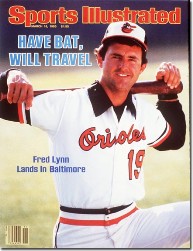
On August 31 – the last day players can be acquired and still be eligible for a playoff roster – Lajoie worked out one of those waiver deals with the Baltimore Orioles. Coming to the Tigers would be 36-year-old outfielder Fred Lynn – a bona fide All-Star in his heyday. Only, this wasn’t his heyday – hence him clearing waivers.

Anyhow, Lajoie makes the trade, but according to MLB rules, Lynn must be in the same city the Tigers are in by midnight that night, or else he can’t be eligible for the playoffs. In other words, he has to literally join the team before the clock strikes twelve. Sort of a twisted, baseball version of Cinderella. The Tigers are in Milwaukee, and Lynn’s Orioles were on the west coast when the trade was made. So Freddie hops some planes and lands in Milwaukee a tad before midnight. I’m not making this up.


This SI cover's headline had even more meaning when the Tigers dealt for Lynn in 1988

Lynn is eligible after all. He hits some home runs in September, plays some good defense, and basically holds up his end of the bargain. But the Tigers end up in second place, one game out of first place, when the season’s curtain comes down. Not enough extra horse power, apparently.

In 1993, Jerry Walker is the Tigers GM and he pries another one-time superstar past his prime, outfielder Eric Davis, from the Dodgers on trade deadline day. Davis easily makes it to Detroit in time, and hits a home run in his first game as a Tiger. But the Toronto Blue Jays have more and better horses, and leave the Tigers in the dust.

Two summers ago, the Tigers rescued Sean Casey from the Pirates. In the World Series, Casey was easily the Tigers’ best hitter, going 9-for-17 with a couple of homers. Last season, the Tigers – although considered buyers by most – stood pat, satisfied with their horses. But too many of them came up lame, and before you knew it, the Tigers were done – shoved ingloriously out of playoff contention by the Indians and Yankees.

This year, the Tigers are fiddling around with .500 and they’re on the cusp of being sellers, but they probably consider themselves buyers, if they’re wearing their rose-colored glasses. Trouble is, glasses or not, one thing never changes.

Caveat emptor.

Monday, June 23, 2008

Carlin's Football/Baseball Comparison Still A Classic

I didn't much care for George Carlin in his later years. I found his cynicism and sarcasm, which had been honed to a fine, poisonous tip during his prime, had turned into just plain old mean spiritedness and simply wasn't all that funny. I would watch Carlin and squirm more than I would laugh.

But I'm still saddened at his passing yesterday at age 71, because, well, he was one of the comedians I grew up enjoying. Plus -- and this is why he's relevant to OOB -- he did a wonderful bit comparing football to baseball.

He would describe the objective of football in a baritone voice, with the drama of a war movie voice-over, then switch to a frilly, child-like voice in describing baseball.

Perhaps the most famous line was, "In baseball, the object is to go home! I'm going home!"

In football there's the "two minute warning" and in baseball we have "EXTRA innings! We don't know HOW long it will last!"

And so on. Good stuff.

I still think of that Carlin bit from time to time, and decided to use this occasion to look it up on that video version of Google known as YouTube.

Enjoy.

Sunday, May 18, 2008

Some Announcers Leave Me With A Score To Settle

You might want to challenge my taste in movies, but one of my favorites is a 1984 send up of gangster pictures, something called Johnny Dangerously. It stars Michael Keaton in the title role, and I just think it’s funny as hell. The late, great Maureen Stapleton as Johnny’s mother was never better.

There’s a scene in the film where the main antagonist, played by Joe Piscopo (whatever happened to HIM?), wants to know the schedule of Johnny’s brother, the district attorney, that night, so he can whack him. So he turns on the radio.

“Should be great weather tonight as D.A. Tommy Kelly attends the premiere of the new James Cagney movie,” the announcer intones. Piscopo turns the radio off.

“Which theater?,” one of Piscopo’s minions asks. So the radio is turned back on.

“At the Savoy, at 38th street and fourth avenue,” the announcer says on cue before being turned off again.

Ken Kal may as well be that radio announcer.

I don’t have too many hard and fast rules when it comes to listening to sports on the radio. In fact, I just have one.

GIVE THE SCORE. You can insert some of those comic strip symbols for cussing in between “the” and “score”, too.

But no such worries with Kal, the Red Wings’ radio play-by-play guy since the 1995-96 season. We’ll discuss who he replaced in just a moment.

Kal doesn’t break my hard and fast rule. Ever. In fact, he just set a new record the other night. I was climbing into my car – Game 4 of the Red Wings-Dallas Stars series already underway. I flicked on the radio. I didn’t have to wonder for very long what the status of the game was.

“...no score as Lidstrom fetches the puck ...” Kal said, literally the moment I turned the thing on. It was better than the announcer in that scene from Johnny Dangerously.

See how simply brilliant that is?


Ken Kal (right) and radio partner Paul Woods

Now, I’ve listened to some of the baseball guys in town over the years – the ones not named Ernie Harwell – and you’d think that the score was some sort of secret, only to be given out on a need-to-know basis. For minutes on end I’ve listened, practically in tears, begging them to tell me what the &%$!# score is. Often I’ve had to wait till the end of the inning before they finally condescend to my request – which by that point has been violently yelled inside my car, with words not fit to print here.

Why, oh why, is the score of the game treated in such a cloak-and-dagger fashion by some of these microphone types?

Speaking of Harwell, Ernie once told me that it was the legendary Red Barber who taught him a trick. Barber used to keep a three-minute egg timer in the broadcast booth. When the grains of sand ran out, he’d flip the timer over. And he’d give the score, too. For that tip alone, Red Barber should have been inducted into the Hall of Fame – of life.


Red Barber


Hockey on the radio can be a fascinating, heart-pounding thing to hear. Without the visual, you have to rely on the tone of the announcer’s voice. And when it reaches a crescendo or rises an octave or two, your heart flutters. For something exciting has just happened – and only the radio guy knows for sure. Kal possesses that change of octaves. But no one was more exciting in that department than Bruce Martyn, who preceded Kal for the 30 years prior to 1995.

Martyn had a voice made for hockey announcing, although he started out as a DJ, spinning records on WCAR. The late George Puscas said that Martyn, who also did Michigan State football games, was the best football play-by-play guy he’d ever heard, bar none. But I only know Martyn as the Red Wings’ radio and TV voice, and I simply can’t imagine him being placed on this earth to do anything else.

“He shoots ... he SCORES!!” Martyn would crackle in that nasally, octave-changing pitch of his, and there just wasn’t anything more fetching on the dial at that particular moment. Oh, and he gave the score, too. It would go something like this.

“Puck sent back into the Detroit zone...picked up there by Bergman...one-one tie...Bergman head mans the puck ...”

Didya catch it?

Kal does it the Martyn way – blending the giving of the score with the play-by-play monologue. It’s seamless and genius and what’s so $#@!& hard about it, anyway?

Television, a few years back, abided my hard and fast rule, capitalizing on its advantage of being a visual medium. Now it’s commonplace to flip on a game on the tube and see the score permanently embedded onto the screen. In fact, it’s hard to imagine that there was a time when that wasn’t the norm.

Now if we can just get the radio folks to cooperate.

Dan Dickerson, the Tigers voice, does a pretty decent job in this area. Not so his partner, the wretched Jim Price, who’s one of those secret-keepers when it comes to the score. George Blaha, thrilling us with his descriptions of Pistons basketball for over 30 years, not only gives the score, he does so with accoutrements.

“Five and forty-five to go in the third....Chauncey on the right wing...six on the shot clock...here’s the triple try...it’s through! And the Pistons lead ‘em by eight, 76-68!”

Blaha has been giving us the score the same way Gallagher gave us comedy: with flair, drama, and a distinct lack of finesse. But always with the accompanying oohs and ahhs.

A simple egg timer. That’s all Red Barber and Ernie Harwell needed to remind themselves to clue their listeners in on the most important statistic of any ballgame. They still make those timers, you know. I saw one at Target the other day. So it can still be done.

Sunday, January 20, 2008

Leyland A Dying Breed: The Quotable Manager

It was very early into a baseball season that would turn magical, when the very mention of the manager’s name would spread the lips of millions of Tigers fans into relieved smirks, then eventually into elated grins.

The crusty Jim Leyland regaled us with a story of a broken down car, an Ohio mechanic, some free tickets, and at the time I had no idea that it would serve as a sign of how things would fall into place for the Tigers in 2006.

A few hours before game time, Leyland accepts, sometimes begrudgingly, the intrusion of journalists into his modest office. Occasionally, there’s even something new to talk about. On this April afternoon nearly two years ago, Leyland, just a few games into his first season back managing in seven years, had something new to talk about.

“I was driving back thru Ohio,” he told us, talking about returning from an Easter-related family gathering in Pennsylvania. Next were details of a flat tire, a car he had to suddenly control at high speed, and a fortuitously located tire store.

The manager had gotten a lift, from a tow truck driver, to the tire store. But not before the driver saw the large duffel bag with the Tigers logo on it. This was squarely in Cleveland Indians country, too.

“Hey, Tigers!” the driver said, according to Leyland, when the tow truck guy started helping the stranded, gray-haired motorist. “I love the Tigers!”

Leyland had us set up for one of several funny lines.

“Yeah? You like the Tigers?” Leyland told us of his response to the young man. “Well, I’m the ***damned manager!”

The first round of laughter erupted in the office.

Later, after Leyland told of getting the royal treatment with his crippled car, he then related his telephone call back to Detroit. He wasn’t sure if he’d make it back in town in time to manage the next day’s game.

“(Third base coach Gene) Lamont says, ‘Jim’s stranded on the road? He’s not OK, is he?”
More laughter, uproarious this time. Lamont would have managed the game if Leyland wasn’t
OK.

And two lucky tire store employees were left free tickets to the next Tigers-Indians game in Cleveland, thanks to a grateful Jim Leyland, about to embark on his magical season in Detroit.

I have just done a very poor job in relating this story, because if ever the term “you had to be there” was appropriate, it’s when Leyland holds court and starts in.

Leyland, then only a few games into what would be a hallmark season in Detroit, is now so firmly ensconced in the manager’s chair with the Tigers that he could probably give Kwame Kilpatrick a run for his money for the mayor’s chair at City Hall.

He’s a dying breed, Jim Leyland is – and I’m very sad to say it. He’s the quotable baseball manager, the kind who gets your juices flowing when you see the punctuation “ “ appear in newspaper stories with his name attached to the “ ‘s.


Sometimes, Leyland is even quotable with the umpires -- just not for family papers


I’m not talking Casey Stengel or Yogi Berra quotable, necessarily. Those were baseball geniuses who occasionally played the fool for good newspaper copy. Leyland is a straight shooter, and he uses wit and plain, brown paper-wrapped wisdom to illustrate his philosophy. But he’s also good for a crack-up.

Think of how many times you read something, to yourself, and break out into laughter. Not too often, for if someone sees you laughing with no one around, they’re liable to place a phone call to the men in white suits.

I cracked up, loud and long, when I read a simple Leyland description the other day. He was talking about the convenience of having Toledo as the Tigers’ Triple-A affiliate.

“Yeah, you can get a guy to Detroit in an hour,” Leyland told a lucky reporter last week. “In my first year managing in Pittsburgh, our minor league team was in Hawaii. You’d call a guy up, and ten days later he’d arrive.”

Like I said, you had to be there – in my brain, as I read the copy. I’m sorry – I thought it was hilarious.

Point being, look around the major leagues and tell me which managers make you look forward to the “ ‘s attached to their names. All I see are cookie cutter, generic, vanilla dudes.

We’ve been blessed in Detroit. We had Charlie Dressen, full of spit and vinegar, who unfortunately got himself so worked up as Tigers manager that he had not one, but two heart attacks during his run in the 1960s. The first one, in spring training 1965, he covered up by explaining that he had to tend to his wife in California. He checked himself into a hospital as soon as his plane touched down. But Dressen was quotable.

So, too, Billy Martin – who was also just plain wacky enough with his managerial moves and gamesmanship to make his verbal output just the cherry on top of a delicious baseball sundae.

Before long, Sparky Anderson blew into town. I needn’t say more.

Leyland doesn’t always enjoy his little media sessions, but you couldn’t tell by the generosity with which he scoops out the sundaes.

That first spring training, in 2006, Leyland was explaining why he lifted a young outfielder prospect from a game.

“Because of the way he was circling around out there looking for a fly ball,” Leyland said. “He took so many twists and turns, I almost smoked a whole Marlboro before he finally caught it.”

Come on – curl your lips into a grin. That’s good stuff.

Thursday, October 18, 2007

Torre Deserves Better Than To Twist In The Wind

If I was Joe Torre, I'd tell the Yankees to take their job and shove it. And that would be the kindest way that I'd phrase it.

I would tell them, "You either want me or you don't want me. Period. So what's the big holdup?"

Torre has been twisting in the wind ever since the Yankees' capitulation to the Cleveland Indians in the ALDS. That makes seven years since the last championship for the Bronx Bombers -- a time frame in which they've blown a 3-0 lead to the Red Sox in the ALCS, seen a heavily underdog Florida team upend them in the World Series, and doing so just two years after seeing the heavily underdog Arizona Diamondbacks upend them in the World Series. OH, and last year, the heavily underdog Tigers upended them in the ALDS.

OK, so there seems to be a pattern of post-season failure here. And if that's enough to cast Torre aside after 12 seasons, then so be it. But so be it SOON, instead of this nonsense where team execs hole themselves up in a conference room in Tampa and emerge with no news as to whether the 67-year-old will manage the team in 2008.

Torre has won four World Series as Yankees manager. Granted, they came within the first five years of his tenure, but he still deserves better than sitting at home, wondering if he'll be back. The Yankees have been out of the playoffs for a couple of weeks now.

It's not idiotic to suggest that sometimes players need a different voice. Torre is easily the longest-tenured manager in the American League because he wins, and because there really hasn't been anyone else who could handle managing under the circumstances that he manages under. Yet 12 years is a long time, and despite the annual trips to the playoffs, maybe it indeed is time for a new leader. Fine. Just make a decision, already.

Just about everyone has weighed in on the Torre Question. Everyone that is, except the people who decide his fate: GM Brian Cashman, and owner George Steinbrenner. All the Internet polls and talk radio discussions in the world don't change this distinct fact: that Joe Torre has no idea what his status with the Yankees is this morning. And that's shameful, even for an organization as filled with drama as the Yankees'.

Part of the drama is self-assigned. I don't know what's taking the powers to be so long to come to a consensus. Either you want Joe Torre as your manager, or you don't. Period. I can see arguments for both yes and no. And, presumably, so can the Yankees brass. They're just taking far too long in sorting those arguments out.

To quote The Clash, "Should I stay or should I go now?"

Yes? Or no?

Sunday, August 05, 2007

Happy Birthday At The Ballpark

I’m going to turn 44 on Monday. It’s not 34, but I’ll take it. For now, I’ll just be happy that it’s not 54 – not that there’s anything wrong with that.

But it’s also not 10, and that’s when I saw Frank Howard jack a homer into left field to tie the Yankees in the bottom of the ninth inning – sort of. Actually, sitting in the upper deck in left, all I saw was the ball in flight, the Yankee outfielder drifting back, and then it disappeared from my view – but the screaming, full house crowd at Tiger Stadium told me what had happened. That, and Hondo rounding the bases in a jubilant home run trot.

44 isn’t 12, either, and that’s when I saw – as sure as I’m typing this – Brooks Robinson drop a foul popup with nobody around him. The man whose name should be forever etched on every third base in every big league stadium for his defensive brilliance, simply dropped it. I can still see it today – the Tigers in the middle of a 19-game losing streak. And even Brooks’s unthinkable bobble didn’t help. The Tigers dropped both games of a doubleheader.

My parents started carting me and some choice friends to Tigers games on my birthday, starting when I was ten and continuing to when I was 16. Amazing that there was always a home date on August 6 – and I didn’t even have a pipeline to the league schedule maker. At least not that I’m aware of. Maybe my folks placed a courtesy call each winter.

That first date, in 1973, ended wonderfully but started horribly.

There was a mix-up of some sort – my mix-up. I was allotted two tickets for two friends.

At this time, I’d like to publicly apologize to Brian Mitter, wherever you are.

Mitter was the victim of a 10-year-old’s lack of organizational skills. Somehow, I told Mitter he could go, after the two allotted tickets were promised to other friends. Can’t even blame it on a computer glitch.

So one of my two friends is already at the house, and while we’re chatting, I see my other lucky friend running across our front lawn, laughing and giggling. But he’s not alone. He’s racing with Brian Mitter.

Can a 10-year-old make a faux pas?

I remember some random things: my mother breaking the news to Brian, Brian crying, my mom calling Brian’s mom, and him trudging home. Not my best moment. My mom even offered to return the birthday gift Brian toted. Brian’s mom let me keep it.

Ahh, but the game.

It was Monday night, and the Tigers-Yankees were that week’s NBC Game of the Week. The Tigers trailed by a couple runs going into the ninth. Then big Frank Howard laced a pitch into the lower deck, and we’re tied. Then I recall Aurelio Rodriguez sliding home with the winning run in the 10th. Wonderful ending, as I said. But 34 years later, I can’t forget the beginning. You don’t think Brian Mitter turned to deadly violence because of it, do you?

1974 was the Indians and, as it turns out, Norm Cash’s last game as a Tiger. Retrosheet.org, simply the best website ever created, gives you play-by-plays and box scores of thousands of games, sorted by year. I knew Cash was released by the Tigers around my birthday, so I looked him up. Says his last game was on the 6th, against the Indians. Seems he pinch hit late in the game and got a single. He was cut by the Tigers the next day. I saw his last big league hit. Then it was my turn to cry.

1975 was the Orioles, and Robinson’s dropsie. The Tigers were losing in bunches, and my dad was irritated. When something went wrong for them early in the ballgame, my father clapped derisively. He rode them hard, but the Tigers lost again.

1976 – I don’t recall. Retrosheet says the Indians were again the opponents. The Tigers won, 3-1. I’ll take their word for it.

1977 – Texas was in town. I sort of remember that one.

1978 – the White Sox, on a Sunday afternoon. Somewhere I still have the scorecard from that one. The Tigers won. The White Sox wore shorts, I believe. Not sure if I did or not. Two days later, as part of my birthday present, I was allowed to go to Toronto with my friend Steve Hall and stay with his aunt and uncle. We took in a couple of Blue Jays games, hoping to laugh at the second-year Jays. They won both games we went to. Go figure.

1979 – the Texas Rangers again, and a twi-night doubleheader. For those too young, the twi-nighters were awesome. Game 1 started around 5:30 or 6:00, followed by another game. It was, as my dad liked to say of DHs, “A LOT of baseball.” They played faster back then, but it was still … a LOT of baseball. Tigers won both games.

Don’t EVEN ask me who went with me to these games. I think I pretty much rotated friends in and out. Kind of like the faces who join Colin Mochrie and Ryan Stiles on “Whose Line Is It, Anyway?” The same suspects, just taking turns.

The tradition mysteriously ended after that ’79 DH, for whatever reason. Maybe I got too old. Maybe the tickets got too expensive. Maybe my rotating friends became too insufferable. All I know is, I haven’t gone to a birthday game since. But I am going to Thursday afternoon’s game, covering it for Michigan In Play! Magazine – three days late and not as a fan. Doesn’t count, I’m afraid. The Streak continues.

I had an old buddy from college, named Todd Dunne. His birthday was in November, and he told me that his dad always took him to a Red Wings game to celebrate.

“St. Louis always seemed to be the other team,” Dunne said.

The Red Wings usually lost, he added. Of course they did. That was long before this city had the gall to call itself Hockeytown. It was a time when it was still trying to lift itself out of “Darkness with Harkness.”

Did anyone ever go with you, I asked Todd. No, he said – just his dad and he.

No offense to the rotating friends, but that would have been enough for me, too. And mom. She put up with her two sports-loving men like a trooper.

After all, who ended up breaking the news to Brian Mitter?

Brian, man – again, I’m sorry. Please don’t kill anyone.

Sunday, June 03, 2007

Two Near The Dugout, Please

I wonder what happened to Eric the ticket taker. He could have moved, with the rest of them, to Comerica Park in 2000, but somehow I doubt it. There aren’t as many windows at CoPa as at old Tiger Stadium, after all. Now the windows are manned, or womanned, by younger whippersnappers. In Eric’s day, it may not have been a prerequisite that one be over 40, and overweight and male, but that didn’t stop ‘em.

Eric was an enabler for a hooky player and bored bachelor, back in the day. I’d check out of work early – or maybe I didn’t go in at all, if it was a day game (something was the matter with me for 24 hours) – and squeeze my car into a space at the business lot on Abbott, near Trumbull. A small hike to the ballpark, and if you made it without any of the bums looking for some spare change, then you almost wanted to go back and do it again, for that must have been a fluke.

I can’t remember when I began using Eric to finagle seats for me by the visiting team’s dugout, but once I did, there was no stopping me. Other than Eric himself, of course.

I was on TV back then, on cable downriver hosting a bi-weekly sports call-in show. One day – this is circa 1991 – I made a solo trip to Tiger Stadium. Back then, before wife and kid, it wasn’t unusual for me to make a sojourn to the ballpark to take in the Tigers game, or to Joe Louis Arena to catch the Red Wings – all by my lonesome. I’d eat dinner out and prowl downtown, too on occasion, sans accompaniment. Probably a bi-product of being an only child.

So I’m standing in line, waiting to buy a ticket, and Eric is in the window – not that I knew his name at the time.

“I know you,” he said.

Beg pardon?

“You’re Greg Eno. ‘The Sports Guys.’”

That’d be me, but how do you know THAT?

Well, he watched the show – fancy that. Lived in Taylor, if I recall.

I didn’t ask for any special treatment – just a good seat, and one, please. Amazing the good folding chairs that can be found when you’re looking for a single.

Amazing, too, what can be dug up when the ticket taker sticks his thumb into the pie.

“Here’s a good one,” he said that first time. Then his head swiveled back and forth and his voice got low. “Close enough to game time. Visitor’s dugout.”

Pleased with my good fortune, I also understood him clearly: if you get to the stadium not long before the first pitch, old Eric can set you up with prime seats – the ones not being used by the mucky-mucks that day.

That first game, I was enamored. Eric had me so close to the dugout that I could put my pop on it in between foamy sips.

I tried it again, a few weeks later. I looked for Eric’s window, and sidled up to it a few minutes before game time.

“Whaddya got?,” I may have said.

This time I was more observant, and he – and I’m not making this up – literally backed away
from his counter and looked below it, as if he had lost a contact lens. He withdrew a ticket.

“Here you go.”

I’d pay my $20 – and actually I think it may have been shortchanging Eric – and settle myself into the hard blue plastic as the Tigers were taking the field.

Sometimes it was later than that. Perhaps a couple of outs had already been recorded by the time I took my spot near the opposing dugout. He’d even ask me to come back to his window in 5-10 minutes, on occasion. Aside from blemishing my scorecard, that was totally acceptable, considering where Eric was placing me.

One evening, I took my friend John Nixon, testing the Eric process. Could he do for two what he had been doing for one?

He could. The Indians were in town.

The Indians were awful then – losing about twice as many games as they were winning. Nixon started talking to pitcher Greg Swindell, who was sitting at the end of the dugout, his back against the wall, his head bobbed over the side that was open to the fans. And Swindell talked back. The Indians manager was John McNamara.

“How’s Johnny Mac?,” Nixon asked Swindell.

Swindell spoke out of the side of his mouth, as if he was letting us in on a little secret.

“He’s losing it,” Swindell said of his manager. “He’s losing it.”

A few weeks later, McNamara was fired. He had, indeed, lost it.

The replacement was Mike Hargrove, one of the coaches. When Hargrove was a player, he went through so many rituals, gyrations, and maneuvers in the batter’s box, between every single pitch, that he had a nickname: The Human Rain Delay. He’d back out of the box. He’d unstrap his batting glove and re-strap it. He’d tug on his jersey. He’d adjust his helmet. He’d stretch his arms and rotate his shoulders. He’d dig his foot back into the dirt as if he was planting himself. He did this between every pitch.

So after the game, which the Tigers won, I waited for Hargrove as he walked back to the dugout from the coaching box.

“Hey, RAIN DELAY!,” I yelled in his direction.

He looked up to see from where the cry came. The nickname was still stuck to him, even as a coach.

One day, an afternoon game against Texas, I sympathized with Rangers outfielder Gary Pettis, a former Tiger. Eric had me in what was becoming my usual location, near the Rangers dugout. In this series, the Tigers had won the first two games in their final at-bat. And on this afternoon, they did it to Texas again. Three straight walk-off wins.

As the crowd cheered, Pettis trudged in from centerfield. He happened to look up and we made eye contact, perhaps 25 feet away from each other. I gave him a slow head shake of empathy. He nodded and shrugged his shoulders and turned his palms up. Translation: What are ya gonna do?

I stopped going to Eric after the 1992 season. I was married and no longer was it as fun to go to ballgames alone, knowing that my lovely bride was by herself. Besides, by then Mike Ilitch had bought the team and the word was that a lot of the old guard was being weeded out – the ushers, ticket takers, etc. In some cases, that was a good thing, considering the Tigers employed some pretty surly, sour folks back then.

So I doubt Eric was even with the team when the Tigers left Tiger Stadium after the 1999 season. Probably just as well. Today, the Tigers sell out just about every game. Even Eric probably couldn’t set anything aside nowadays.

It was fun while it lasted.

Sunday, May 27, 2007

The Popup That Never Came Down

As a baseball player, I peaked at age 14 and was washed up by age 15. A has-been before I was even a high school sophomore.

But I had my moment, which is all anyone can ever really ask for, I suppose.

It dawned on me that it was 30 years ago this summer when I put a team on my back, carried it for awhile, then caught the biggest popup of my life.

I look at the photo now, taken by my father in my backyard, and the first thing that I notice is how much of a beanpole I was. The uniform was pinstriped in blue, and it made me look even skinnier than I was. The pose was a batting stance, surely copied from some Topps baseball card of the day. But after 30 years the photo remains, a wallet-sized pic in a small frame which sits on an old cabinet in the basement.

The team was Bra-Con Industries, and no, that first part isn’t short for brassiere. Long “a” please. Though I have no idea who the heck Bra-Con Industries was, or is. All I know is that they sponsored our ballteam, as evidenced by the block “BRA-CON” splayed across our chests. It was the first time I got to wear a real baseball uniform – double-knit top and pants, with stirrup socks, too. I wore #11 – Bill Freehan’s number with the Tigers. But I was a second baseman. And a pitcher. And, for the most part, a poor hitter. Until I was sprinkled with magic pixie dust for a few weeks in the summer of ’77.


We played in a league in Livonia. Our nemesis was a team sponsored by Don Massey Cadillac. Oh, how I hated those guys. They had nicer uniforms, they had equipment bags for each player, and they traveled in one big van, like some sort of commune. But they could play some mean baseball. Each time we played them, they spanked us good – the scores progressively worse every time we locked horns with them.

So first place was out of the question, but that didn’t mean we had no playoff hopes. But I’m getting ahead of myself.

Our manager was a roly-poly guy who kind of reminded me of Don Zimmer as I think back on it. But with far, far less baseball acumen. Sadly, I’ve forgotten his name, but I remember his kid was on the team. The old man’s big thing was getting the equipment put away on time. Seriously. He had a fetish for gathering the bats and helmets and depositing them into their respective bags – while the game was going on. It didn’t help team morale to see the skipper putting away the gear while you’re trying to mount a last-inning rally. But as sure as I’m sitting here, that’s what he would do.

His assistant, though – that man’s name I remember. It was Mr. Nadratowski. His kid was on the team, too – John, our catcher.I think Mr. Nadratowski was going thru a divorce or something distressing at home. That, and I think he drank a little bit.

But he was a great guy, and he knew far more baseball than Mr. Equipment Manager.

The big turnaround came when Equipment Manager left the team suddenly. I can’t remember if it was a planned vacation, a resignation, or what, but all I know is the team was left under the control of Mr. Nadratowski. Thank goodness. He made some lineup changes immediately. Then I got hot.

I had been scuffling along, playing a solid second base and taking my turn every few games on the mound. But hitting at a mediocre clip, as usual. Then, for a few glorious weeks, my bat turned to gold.

I still don’t really know what happened, except to say that I was simply torrid. It got so that the parents would get extra excited whenever I came to the plate. I smacked the ball pretty good for about five or six games, lifting my batting average well over .300. Heck, it may have been over .400.

The biggest hit was a triple I drilled off a kid named Greg Everson. But Everson wasn’t just any kid pitcher. He was so good, in fact, that he became a minor leaguer – reaching AAA at one point. I looked him up on Google, and found that the Tigers, who had owned his rights, traded him for big league pitcher Jerry Don Gleaton of the Kansas City Royals, on April 2, 1990. Retrosheet.org confirmed this.

So this wasn’t chopped liver I was batting against. Yet I took him deep to left center, and legged out a three bagger. It was the peak of my hotness. Then, moments later, the next batter lined out to the third baseman, who promptly tagged the bag, doubling me off. Sixty to zero in 3.2 seconds.

I cooled off a bit, but we were still a solid second place team, trailing Don Massey Cadillac of course. The second place finish meant we would qualify for some sort of city playoff. Kind of like a runners-up championship.

The game was played at Livonia’s Ford Field (it’s still there), on Farmington Road and Lyndon.

It was a nip-and-tuck affair. Then I came to the plate in the late innings, a man on third with one out. I managed a sacrifice fly, driving in the go-ahead run.

Still clinging to that slim lead in the last inning, our opponents put a man on base with two outs. Can’t remember what base, however. Doesn’t matter. Playing second base, my eyes got as wide as saucers as the next batter popped up, high into shallow right field. It was my ball. MY ball. I waved everyone off. It felt like it would never come down. But it did, finally, and I squeezed it as tight as I could. Ballgame over. City championship won.

I was mobbed by my teammates. It was the only time any team I had played for had won anything of any significance.

We each got trophies (it’s still in the basement, too) with our names on it. But the best part was at the postseason banquet, when we received our trophies. It was held at a local pizzeria. Mr. Nadratowski, still battling his personal demons at home, got up in front of everyone and said some words. I remember him thanking us, the kid players, and then starting to sob. I think we had brightened his life somehow.

Funny, but I’m starting to tear up a little bit now, 30 years later.

Wish I had kept the damn ball.

Wednesday, April 11, 2007

Aaron's AWOL Status Huge Blow Against Bonds

About 25 years ago or so, he made a subtle lobbying effort to be considered a candidate for commissioner of baseball. This after a much-publicized complaint that he was one of the few blacks employed as a baseball executive. And that after enduring what no hard-working American should have to at the workplace, in the midst of his pursuit of baseball's all-time homerun record.

Now Henry Aaron is again showing us the resolve and, frankly, brass baseballs that make him one of the most underrated icons that this country has ever seen -- at least since World War II.

Aaron publicly admitted that he plans to be nowhere in sight when Barry Bonds has a chance to break his all-time HR record of 755, which could very well happen this summer. Bonds is 22 away.

"I'd probably fly to West Palm Beach to play golf," Aaron was quoted as saying in Terence Moore's column the other day in the Atlanta Journal-Constitution. "Again, it has nothing to do with anybody, other than I had enough of it. I don't want to be around that sort of thing anymore. I just want to be at peace with myself."

Certainly Bonds's run is re-opening old wounds for Aaron, who went through his own personal hell as he chased Babe Ruth's 714 back in 1973-74. But that was the result of the disgusting, lowest form of citizenry -- the racist boobs who would resort to even death threats and kidnapping his daughter if he went through with his assault.

This time, the backlash has nothing to do with Bonds's skin color and everything to do with the magic creams and elixirs and pills that he probably applied and inserted into his body over the years, turning him from baseball's version of Bill Bixby to Lou Ferrigno.

It's a record-breaking that even today's mealy commissioner, Bud Selig, seems completely unable to handle or address.

Not so with Aaron.

"I don't want to answer questions. It's going to be a no-win situation for me anyway. If I go, people are going to say, 'Well, he went because of this.' If I don't go, they'll say whatever. I'll just let them make their own mind up."

And this: "I'm 72 years old, and I'm not hopping on a plane and flying all the way to San Francisco for anybody."


Aaron doesn't care to see Bonds repeat this scene from 1974

So there you have it. The current homerun champ, 33 years into his reign, has spoken and there's no doubt where he stands. We can't come close to saying either about Selig.

I'm sorry, but this is huge. Baseball's HR record might be the sexiest, most alluring of all the sports records, bar none. And to hear the current champ say he wants no part of the celebration -- however muted -- and will even go to lengths to avoid it, speaks volumes.

For his part, Bonds took the high road in reaction to Aaron's comments.

"He has every right to do what he wants to do. I respect that," Bonds said. "There's no reason for me to be disappointed. If he has other plans, other things to do, I respect that. He's his own man. He can do what he wants to do. I respect that. No hard feelings."

But I would be shocked if those words weren't trying to mask a certain hurt that Bonds must feel over Aaron's stance. Whatever you feel about Barry Bonds, Aaron's refusal to be present when Bonds breaks his record is a tough blow for the Giants outfielder. It has to be.

Prior to this week, we were waiting to hear about Bonds's imminent ascent to the homerun throne from two key individuals: Aaron and Selig.

Predictably, the latter is the one who still remains silent.

Monday, April 02, 2007

Whether It's Opening Day Or Opening day, It's Special

Jim Bouton had it right.

Today is either Opening Day, or Opening day -- depending on how you feel about it.

Bouton, the former big league pitcher and author of the groundbreaking book, "Ball Four," described baseball's first day thusly in his book. He also ended it by saying that, as a ballplayer, you spend your life gripping a baseball, and it turns out it was the other way around the whole time.

Today is an unofficial holiday in Detroit -- maybe it IS official, come to think of it. Work attendance is going to take a hit today. But do schoolkids still carry tarnsistor radios with them, and listen to the game surreptitiously? Doubtful, but then again they have BlackBerries and other devices with which to monitor the match's progress.

In my school daze -- I mean days -- our teachers would have a TV rolled in by the geeky A/V dude, and he or she would let us watch a few innings. This was circa the early 1970s. But I also remember doing the transistor radio thing outside during afternoon recess. In 1972, when the Tigers were in the ALCS, the TV privilege returned. I remember hustling home to watch the final innings of the decisive Game 5 -- a heartbreaking 2-1 loss. But back to Opening Day/day.

Few cities, if any, I believe, do it better than Detroit -- though I've never experienced another city on Opening Day/day. I just can't imagine any city's denizens celebrating it the way we do here. It's still not QUITE the same as it was during the Tiger Stadium days, but it's more than just about the ballpark, of course. It's an environment. An underlying feeling of fellowship. The few times when we all feel like we're in this thing together.

Proof of this is that you don't even need a ticket to the game to feel the energy. I've never done so, but one year I might just go downtown, sans ticket or media credential, and just hang out -- walking around and keeping my eyes and ears open. Yes, I just might do that someday.

Today I'll be in front of the tube, watching it on FSD. It can be special at home, too. Plus, free parking.

Sunday, April 01, 2007

95 Reasons

“Oh, baseball, how do I love thee? Let me count the ways…”
And here’s 95 of them – one for every game the Tigers won in 2006.

1. The smell of hotdogs
2. The taste of hotdogs
3. The tiny scorebook pencil
4. Triples
5. Out-of-town scores
6. Curtis Granderson’s smile
7. Jim Leyland’s honesty
8. A first baseman’s mitt
9. A child with a ballcap on
10. “Play ball!”
11. The payoff pitch
12. The knickers of the late-1800s
13. The collared shirts of the early-1900s
14. Nicknames like Dr. Strangeglove
15. “The weatherman says we’re gonna get this one in”
16. Purpose pitch
17. Pitchers batting
18. The rosin bag
19. The on-deck circle donut
20. Magic numbers
21. 6-4-3
22. A cannon arm in the outfield
23. Julio Franco
24. The ambient ballpark sounds on radio when the announcers aren’t talking
25. A good manager/umpire argument
26. A good bunt
27. The Charley Lau way of swinging the bat
28. September callups
29. A popup to kill the opponent’s rally
30. Champagne showers in a victorious locker room
31. Shoe polish marks on a baseball that’s hit a batter’s foot
32. Yogi Berra
33. Pete Rose slamming into Ray Fosse
34. Willie Horton throwing out Lou Brock
35. Bill Freehan blocking the plate
36. Sandy Koufax shutting out the Twins on two-days’ rest in Game 7 of the ’65 Series
37. The fact that even the most pedestrian pitcher can throw a no-hitter on any given day
38. Players who homered in their first big league AB
39. Games of pepper
40. And pickle
41. And ‘500’
42. “A fan from Lapeer caught that one”
43. And the man who said it on the radio
44. The postgame spread
45. Baseballs still rubbed with Delaware River mud, before every game
46. Retired players who become spring training instructors
47. A three-run homer
48. Stealing third base
49. Brandon Inge
50. Norm Cash
51. A gapper into left-center
52. Slow guys running the basepaths
53. Lou Brock’s daring leads from first base in the 1968 World Series
54. And Mickey Lolich picking him off
55. Peanuts and Cracker Jack
56. Waving everyone off so you can catch the popup/flyball
57. Dick McAuliffe’s batting stance
58. “They’ll be off at the crack of the bat; EVERRRYONE will be running”
59. Knuckleball pitchers
60. And the fact that they’re NEVER lefthanded (other than Wilbur Wood)
61. Eating ice cream out of a miniature batting helmet bowl
62. Keeping score
63. Dizzy Dean
64. “When It Was A Game” (and its sequels)
65. The 3-0 pitch is always a strike
66. And the 3-1 pitch is always fouled off
67. That men actually hit .400+ once upon a time
68. And pitchers routinely won 30+ games in a season
69. A “bang-bang” play at first base
70. Ladies/Retirees Day
71. Family Night
72. Doubleheaders
73. No lights at Wrigley Field until 1988
74. The Green Monster
75. “The short porch in right”
76. Game time temperature of 78 degrees
77. Games under three hours in length
78. The Gates Brown “sliding into second base with a hot dog in his pants pocket” story
79. And the fact that it’s not apocryphal
80. A cleanly-fielded bunt followed by a rifle throw to first base
81. Watering down the infield dirt
82. And changing the bases in the fifth inning
83. Rally caps
84. Batting helmets at Tiger Stadium for $2.00
85. Fat Bob Taylor singing the National Anthem, because that meant it was an important game at The Corner
86. Booing politicians on Opening Day
87. And the commissioner, if he shows up at your ballpark
88. A game of catch
89. The throw from catcher to second base after the pitcher’s warmup tosses is always dead solid perfect
90. Joe Garagiola
91. Bob Uecker
92. Ernie Harwell
93. “He comes out of the dugout swinging”
94. The Hot Corner
95. Called strike three to end the game for the hometown team

So there you go. And beware, Kwame Kilpatrick and Jennifer Granholm; you’re about to hear the boobirds Monday afternoon.

Hey, it’s only tradition.