When Nick Lidstrom first suited up for the Red Wings in 1991, George Bush was president---the first Bush. The Tigers' first baseman was Fielder---the first Fielder. Joe Dumars was hard at work at the Palace---as a player. The Lions were having a season that would find them in the NFC Championship Game.
It was a long time ago.
In 1991, we had no idea that this Swedish defenseman, an NHL rookie, would grow up to be the greatest blueliner of his time---and maybe of all time.
It wasn't like when Bobby Orr burst onto the scene in the 1960s. With Orr, greatness seemed inevitable. Orr was unlike anything we'd seen before. Before Orr, no defenseman made an end-to-end rush. No defenseman could skate like Orr. No defenseman could pass like Orr.
NHL defensemen before Bobby Orr treated the rink as if there was a force field beyond the center red line. They were among the worst skaters and were often placed on defense because of that lack of ability. Being a defenseman was like being the kid deposited into right field during a game of pickup baseball. Or the street football player who was told on every play to "go long."
The NHL defensemen of the Original Six era scored exactly one goal each, every season. They had more bruises on their body from blocking shots than they had points. They had names like Doug Harvey and Leo Boivin and Moose Vasko. They were so heavy on their skates they created divots on the ice.
So when Orr arrived, it was like when the electric guitar first screeched on the nation's 45s.
A guitar can do that?
A defenseman can skate? Shoot? Pass?
Nick Lidstrom snuck up on us. He didn't do anything in a flashy way. He didn't wow us. He didn't reinvent the position, like Orr did.
All he did was play it perfectly---for 20 seasons.
That's the irony of Lidstrom's career, which came to an end in one of those press conferences in the bowels of an arena where the athlete toiled. The end came, as it always does, with the athlete wearing Armani instead of Nike and speaking into a single microphone instead of the cluster that is thrust at him in the locker room after the game.
When the news broke yesterday that there was a press conference called for today involving Lidstrom and GM Ken Holland, didn't we all feel like we were told that the coach wanted to see us, and that we'd better bring our playbook?
We all knew. We tried to theorize that there was some reason, any other reason, for the presser.
But we all knew.
The irony is that Lidstrom was the Perfect Defenseman yet he managed to do so in a manner that rarely stood out.
When you ask a hockey person about what they liked most about Orr there is quite a menu.
When you ask a football fan about Barry Sanders and what they liked most, you might as well have a seat.
Back to the Red Wings: ask someone who watched Steve Yzerman play in Detroit for 22 years about Stevie's characteristics and the superlatives will flow: toughness; determined; focused; warrior; leader; heart and soul.
But ask the same folks about Lidstrom and there'll be yammering and stammering before the person finally blurts out "Perfect!"
Yes, that sums it up, but how can someone play his position perfectly yet leave so few words for us to use to describe the perfection?
It was clear that when we paid to see Barry Sanders, we paid to see him juke, twist, stop and start and split into two in order to avoid a tackle.
We paid to see Cecil Fielder hit a baseball over the left field roof of Tiger Stadium---or strike out mightily trying.
We paid to see Yzerman play on one leg, gut through a horrific eye injury, and grind his way over, around and past the Colorado Avalanche.
But what did we pay to see Lidstrom do?
Using a hockey stick like a skilled surgeon would wield a scalpel? Never being out of position? Seeing the rink like Bobby Fischer would see a chess board? Playing the angles like Minnesota Fats played the cushions?
Lidstrom did all of that, but it wasn't "pay to see it" stuff.
Perfect isn't exciting. We're more enthralled by the imperfect with style and panache.
Lidstrom had neither style nor panache. He appeared to blend in, until you bothered to stop and recall a time when he made a mistake---and couldn't think of one.
So what now, with the announcement of Lidstrom's retirement this morning?
Well, the Red Wings can go out and sign free agent Ryan Suter. But frankly, they could sign three Suters and I'm not sure it would be an upgrade. And that's no knock on Suter, any more than saying three Ford Mustangs aren't an upgrade over a Lamborghini.
First, when discussing the Red Wings without Lidstrom, please refrain from using the R-word.
Replace.
You don't replace Nick Lidstrom. Let's get that straight right now.
All the Red Wings can do is cobble together as much talent as they can on defense and hope for the best, really. They're a much worse team now than they were yesterday, no question.
But all is not lost. Plenty of teams have won the Stanley Cup without the greatest defenseman in NHL history on their roster. I mean, look who's playing for the Cup right now.
The sun will rise tomorrow. It's just hard to imagine that it will, after it set on Nick Lidstrom's career today.
Showing posts with label Nicklas Lidstrom. Show all posts
Showing posts with label Nicklas Lidstrom. Show all posts
Thursday, May 31, 2012


Sunday, October 30, 2011
Life Without Lidstrom Terrifying Thought For Red Wings, Fans
Nick Lidstrom doesn’t block shots. He doesn’t body check anyone. He’s never thrown an elbow. His next fight will be his first.
The greatest hockey defenseman of his time—or maybe of any time—isn’t supposed to be so mild-mannered. He isn’t supposed to be less physical than a second baseman.
Lidstrom, the Red Wings' all-universe defenseman, is 41 years old. In human years.
In hockey-playing years, he’s closer to 30, because he hasn’t used his body as a battering ram or for someone else’s target practice.
Lidstrom plays hockey like Bobby Fischer played chess and Minnesota Fats played billiards—literally. No one has seen that 200’x80’ sheet of ice better than Lidstrom, who is always a move or two ahead of his opponent. He’s the geometric hockey player—using the puck’s caroms and angles like Fats used those green felt rails.
There hasn’t been a defenseman like him, before or since he entered the NHL in 1991. I’ll put up a batch of my wife’s Pasta Fagioli that there won’t be one like him after, either. Ever.
He’s 41 and despite his lack of wear and tear, Lidstrom is on the back end of his career. Only a delusional fool would believe otherwise.
The topic came up Monday night on “The Knee Jerks,” the podcast I co-host each week with Big Al Beaton of The Wayne Fontes Experience.
What will life be like, we wondered, when Lidstrom neatly folds his sweater and hangs up his skates?The word “terrifying” came up, more than once.
It’s an annual question—one that we ask without really wanting to know the answer. You ask the question and then bury your face in something, shivering.
Last spring, Nick made us sweat a little bit more than normal. It took several weeks after the Red Wings were once again eliminated in the second round of the playoffs by the San Jose Sharks for Lidstrom to consent to play his 20th season.
They could hear the sighs of relief from Detroit all the way to, well, San Jose.
It’s not just that Lidstrom has played 20 seasons, or that he’s played them flawlessly, or that he’s the perfect teammate or that he seamlessly took over as captain from Steve Yzerman, no less—which is like a singer stepping onto the stage right after a set by Sinatra and no one noticing.
No, it’s that Lidstrom has done all that while hardly missing a game.
His games-played column reads like an early-summer thermometer: 76, 78, 80, 77, 79, 80, 81.
The spooky notion of no more Nick Lidstrom is just as much the fear of the unknown as anything else.
We don’t want to think of the Red Wings without Lidstrom because we haven’t really seen the Red Wings without Lidstrom since before he was a Red Wing.
It’s History 101.The last time a Red Wings roster didn’t list Lidstrom’s name, George Bush The First was President. The Pistons were the defending NBA champs—but they were the Pistons of Isiah and Dumars, not Chauncey and Hamilton.
There was no Internet.
The kids graduating high school this year were still two years from being born.
Need I go on?
Lidstrom’s longevity is one thing; his durability is quite another.
As much as Yzerman is revered in Detroit—and he should be—Steve wasn’t exactly an Iron Man, unless you count his days spent in those hyperbaric chambers. Stevie Y was more Iron Lung than Iron Man.
Yzerman missed games in chunks, due to various injuries. He was the anti-Lidstrom, in a sense.
There was a serious knee injury in 1988. But that wasn’t the worst of it. As Yzerman got older, his body broke down more frequently. He played the 2002 playoffs on a knee so mangled that he managed to report to work for just 13 games the following season, recovering from the knee’s reconstruction.
There was more time lost in the 2005-06 season, Yzerman’s last as a player.
So we had heaping spoonfuls of Red Wings life without Steve Yzerman, making his retirement no less sad—just less of a shock to the system.Not so with Lidstrom, who has played with mind-numbing consistency and Lou Gehrig-like durability.
We have not been prepped for Lidstrom’s retirement.
If the Red Wings fan base thinks that another Lidstrom is being groomed, or that he can in any way be replaced, forget it. Not going to happen.
This is no affront to Niklas Kronwall or Brad Stuart or Jonathan Ericsson or to any of the prospects in the Red Wings’ system.
Players like Nick Lidstrom come by once in a franchise’s lifetime—if that.
How will the Red Wings ever replace him?
Did the Boston Bruins replace Raymond Bourque?
Yzerman, for all of his Hall of Fame worthiness, was in the process of being phased out by the time he retired in 2006. The cache of forwards the Red Wings employed made Stevie’s departure easier to digest.
All the Red Wings can do when Lidstrom finally bids farewell—and it’ll be sooner rather than later—is take a deep breath, exhale and hope that they have a defensive corps that can band together and do one of those “the whole is greater than the sum of its parts” kind of things.
Because if you think he’s going to be replaced, you’re mad.The Red Wings have had four—four—players who’ve played 20-plus seasons for them: Lidstrom, Yzerman, Gordie Howe and Alex Delvecchio.
This is significant.
The Montreal Canadiens, for all their history and Stanley Cups, have had just one player—Jean Beliveau—play as many as 19 seasons for them.
The Toronto Maple Leafs have had only George Armstrong play 20 seasons wearing the Leaf.
The New York Rangers have no 20-plus-year men.
The Boston Bruins have only Bourque, who played a tad over 20 in Beantown.
The Chicago Blackhawks had Stan Mikita for 21 years. That’s it.
The Red Wings have had four such men. It’s significant.
The most recent of the Red Wings’ 20-plus-year men might leave a void that none of his predecessors left—not even Howe, for Gordie “retired” with the team well on its way to being miserable for an entire decade.
How do the Red Wings replace Nick Lidstrom?
They don’t.
I guess he’ll just have to keep playing until we figure something out.
Monday, May 09, 2011
Captain Nick Keeps Us Guessing re: Retirement
I wonder how many of the 20,000-plus throng at Joe Louis Arena on Friday night were aware that they may have just missed an historic moment. Or rather, dodged a bullet.
The Red Wings won, 4-3, thanks to some late heroics by that bottomless pit of energy, Darren Helm. This keeps playoff hockey alive in Detroit, as the San Jose Sharks missed out on their chance to sweep the Red Wings into the Detroit River and out of the post-season.
But as the mostly red-clad crowd whooped and hollered, both after Helm’s goal with 1:27 left in the third period and after the final horn sounded, how many realized that they did not just see Nicklas Lidstrom play his final game?
The fans may have been just that 1:27 and some overtime hockey away from Lidstrom skating off the ice for the final time, had the Red Wings lost.
You’d like to say that Nick Lidstrom is not allowed to retire, just as Monday is not allowed to come after Friday, and a red light is not allowed to come after green without amber in between.
You’d like to point to Lidstrom, who’s 40, and argue that he can’t call it quits because as efficiently as he’s played during his career, his 40 is a 40 in number only and Nick has the body of a 30-year-old, tops. His is the only birth certificate that could be categorized as fiction.
You’d like to say that a guy can’t hang up his skates after a season in which he was nominated for the Norris Trophy, yet again, as the league’s best defenseman. Somewhere there surely must be a by-law against that.
You’d like to scoff and say, “How can a guy quit when he has 44% of his team’s goals in this series with the Sharks?” Yes, Lidstrom has four of the Red Wings’ nine markers in this tussle with San Jose.
The thought of Red Wings hockey without Nick Lidstrom is, at the same time, sad and downright terrifying.
But Nick is 40 and we’re at the point now where every summer, the question gets bandied about. Will Nick retire, or will he come back? Will he abscond to Sweden and leave us on our knees, sobbing and crying out, “NIIIIICK!!!”
Or, will he report to Traverse City in September, like he has since 1990, pull on the sweater with the big “C” on the right breast and declare himself ready for another “kick at the can,” which is hockey talk for trying to win the Stanley Cup?
This isn’t like when the previous captain, Steve Yzerman, retired in 2006.
Yzerman, at age 41, had a body that had been ravaged by injury, mostly below the waist and above the ankles. The stories of the pain he put himself through were both legendary and gruesome. And who can forget when he was felled by a shot puck in the eye against Calgary in the 2004 playoffs?
We could see Yzerman’s retirement coming like the next train at the People Mover station. The word “imminent” comes to mind.
But Nick Lidstrom hasn’t suffered the kind of injuries that Yzerman endured. In fact, Lidstrom has hardly suffered any injury, period.
Save for a few more whiskers, Lidstrom looks pretty much the same as he did in 1990, when he was a rookie. Lord knows he pretty much looks the same on the ice, too.
Check that: he’s immensely better than he was in 1990.
So Lidstrom’s retirement doesn’t have that same feeling of inevitability, because the guy still looks damn good. His body hasn’t been wearing down, like Yzerman’s did.
Yet here we are, possibly—again—on the verge of seeing Lidstrom play his last game as a Red Wing. His team trails the Sharks, 3-1 in the Western Conference Semi-Finals and Nick’s career is either hanging on by a thread or it’s in no danger whatsoever of being finished.
No in between.
Lidstrom, as usual, isn’t tipping his hand about whether he’s returning next season or not. Some might wink and say that he’s got a face for poker. But can you imagine Nick at a poker table? He couldn’t keep a smirk off his face if he was holding a pair of twos, let alone a royal flush.
Lidstrom is too nice, too down-to-earth, to fool anyone at poker. So it’s not a poker face he’s giving us; I truly believe he hasn’t made up his mind yet. Simple as that.
This has been going on for years now. First, the consideration was whether Nick wanted his kids to attend school in the States or in his homeland, Sweden.
Now it’s simply, does Nick want to play again?
Lidstrom has said that there are two main factors to his continuing to play: 1) that the Red Wings are legitimate Stanley Cup contenders; and 2) he still enjoys playing.
Whether the Red Wings survive the Sharks series or not, the answer to No.1 would appear to be, YES, they are. Here’s Lidstrom himself, quoted in the Free Press on Friday.
“Looking at the lineup we have, looking at the depth we have and the core group that are in their prime right now, I have no doubt they’re going to be a successful team.”
I say that’s a YES to No. 1, though leave it to Lidstrom to send mixed signals; first he says “we,” then he says “they.” Oh, Nick.
As for No. 2—whether he still enjoys playing—I don’t see where he’s not enjoying playing. He had one of his best offensive seasons, he’s got that Norris nomination, and he speaks glowingly of the talent level on the team. Doesn’t sound like someone with a sour puss to me.
If you held a gun to my head and forced me into a prediction, I’d say that Lidstrom comes back next season, at age 41. But it’s not for sure, and that’s what could drive people batty if they dwell on it too long.
Do you think it’s a coincidence that the Red Wings’ current streak of making the playoffs for 20 years in a row began when Lidstrom’s career in Detroit began? Hell, not even Gordie Howe had such a streak, though Yzerman came close—Stevie made the playoffs in 20 of his 22 seasons.
The Red Wings won on Friday night in dramatic fashion, the Hockeytown denizens boogied in the aisles, and everyone is waiting to see what happens in Game 5 in San Jose on Sunday.
And Nick Lidstrom’s splendid career hangs on by a thread.
Or not.
Wednesday, November 10, 2010
Ageless Lidstrom Still NHL's Best
The best hockey defenseman in the world is 40 years old, but that's by birth certificate only. He has the shell of a 40-year-old but the insides of someone 20 years his junior.
Nick Lidstrom isn't a human being. I've come to that conclusion. He's a robot, the result of some mad scientist's secret project. Mike Babcock doesn't coach Lidstrom, he just makes sure Nick's battery pack gets plugged in after every game.
The paperwork will tell you that Lidstrom was drafted in 1989. Don't believe it; that's when he was animated.
The Red Wings keep Lidstrom in storage all summer and then break him out in October for another 82-game sojourn through the NHL. Babcock sends him over the boards to the tune of 25-30 minutes a night and that's the end of the coach's worries about Lidstrom's performance.
Lidstrom has played in the league for about 20 years and there isn't a scratch on him. In a game of ramrodding and elbows to the mouth and crosschecks to the back, Lidstrom has emerged virtually unscathed after two decades. He's not human.
It may be among the most unbelievable feats in all of sports that Nicky Lidstrom can be the best defenseman in the league on an annual basis yet not hit anyone, not even by accident. You'll get jostled more at the mall during the holiday season than the physical damage Lidstrom has doled out in 20 years.
In a game of speed and collisions, Lidstrom sees the hockey rink as a giant chess board surrounded by billiard cushions. He doesn't have to hit you because he plays the angles; he knows where the puck is going because he sees where it's coming from. He doesn't bother with bodychecking because why check someone after you've stripped him of the puck?
Lidstrom is 40 and is playing this season fresh as a daisy. In 13 games so far, he has two goals and 13 assists for 15 points. He's been whistled for all of six penalty minutes. Lidstrom is the only player in the league who the refs apologize to on his way to the penalty box, because surely there must have been some kind of mistake.
Lidstrom plays hockey with the efficiency of a coffee filter, and with about as much effort. He plays 30 minutes a game but he doesn't actually play them, he conducts them, like clinics. Have you ever seen him sweat?
Lidstrom isn't human, I'm telling you.
This is a man who ends opponents' rushes into the Detroit zone like an altar boy with a candle snuffer. Some Fancy Dans have tried stickhandling past him, but that's like trying to beat a frog in a staring contest, or a man trying to win a fight with his wife.
Others have tried sucking Lidstrom into them and then passing the puck, but Nick's hockey stick is more precise than a surgeon's scalpel. He's ruined more passes than a girl in a bar full of drunks.
Lidstrom isn't human; how else to explain why he's playing at the highest of levels, still, at age "40" (snicker, snicker)? How else to explain why he doesn't lose the Norris Trophy, he only lends it out?
Lidstrom isn't slowing down because neither do rechargeable batteries.
It's not just the defending that makes Lidstrom unworldly.
On Monday night in Detroit, the Red Wings were trailing 2-1 in the third period with about seven minutes left in the third period. They were tired and worn from having jetted from Vancouver the previous day. When the players woke up to drive to the arena, their bodies said, "Are you kidding me?"
Except for Lidstrom, of course.
His team needing a goal, Lidstrom teed up one of his signature slap shots from the point and blasted it where Phoenix goalie Ilya Bryzgalov wasn't---in the lower right corner of the net.
That's the other thing---Lidstrom is the Wee Willie Keeler of defensemen; he hits them where they ain't.
Lidstrom tied the game and the weary Red Wings managed a winning goal in overtime, after which Lidstrom skated off the ice and back into his charger.
Lidstrom is 40 and they've been asking him for several years now how much longer he's going to play. He's long been accused of wanting to return to his native Sweden and enjoy his golden years there.
They started this kind of talk four or five years ago and look who's still in Detroit, still in the NHL, deflecting passes and getting in the way of shots and popping in about 12-15 goals a year.
Not that they're going to stop asking. Lidstrom isn't getting any younger, you know.
But he's not getting any older, either.
Thursday, April 29, 2010
Lidstrom at 40: Still Pretty Damn Good
They say Nick Lidstrom isn't the defenseman that he once was. He's not as sharp; maybe has lost a step.
That's OK. Lidstrom can lose three or four steps, as far as I'm concerned. His stick is still in its mid-20s.
It's laughable, anyway, to accuse Lidstrom, the Red Wings' Hall of Fame defenseman, of losing a step. That's like crabbing that the Leaning Tower of Pisa has dropped another centimeter.
Speed and "steps" were never part of Lidstrom's game. You don't have to be blazing of foot to launch howitzers from the blue line. Or to look at the game as a bunch of angles, as Lidstrom does.
The Red Wings are in the second round of the playoffs because players like Lidstrom raised their game to a level that couldn't be matched in Game Seven against the Phoenix Coyotes.
The Red Wings turned the drama of a Game Seven into slapstick hockey. It was like tuning in expecting to see "Gone With the Wind" and getting the Little Rascals instead.
6-1, the Red Wings won. Lidstrom had a couple of goals, an assist, and he played all the angles correctly. Again.
The critics were out on him, especially after Game Six, when Nicky was on the ice for three of the Coyotes' goals---albeit two of them on the power play.
He was about to turn 40 at that point (he did yesterday), so it seemed fair to question whether his skills were slipping.
Lidstrom could slip and slip some more and I'd still take him over a majority of the defensemen in the league.
And as for Game Six's supposed struggles, I'll say this: I haven't seen Nick Lidstrom play two poor games in a row. But then again, I've only seen him play for 19 seasons.
Lidstrom is the team captain and they knock him for that, too.
He's not vocal enough. The team has no personality. We miss Steve Yzerman.
Contrary to popular, misguided belief, you don't have to yell and scream to be a good leader.
All I know is, when October rolls around, you fit Lidstrom with fresh batteries, turn him on, and 82 games later he's racked up another near-perfect season. Still. You don't think that inspires his teammates?
He didn't win the Norris Trophy last year, and won't win it this year, either. But he has six of those and he needs another to validate his legacy like a hole in the head.
Then there's that stick he has. The stick of a 25-year-old. It says here that Lidstrom has used his stick better than any defenseman that's ever laced up a skate. He can go an entire game without throwing a bodycheck but the desired result is the same: scoring chances are denied.
Lidstrom is the well-mannered defender. He practically says "sorry" and "excuse me" while he relieves you of the puck. He wouldn't lose his temper on the ice if you called his mother names. In a sport that's famous for a bump and a cross-eyed look turning into World War III, Lidstrom manages to defend his zone with nothing but his savvy, his stick, and a wink.
So it's the San Jose Sharks next for the Red Wings, who are trying to coax another long playoff run out of their old legs.
Two of those legs belong to Nick Lidstrom, who supposedly has lost a step or two from them.
Keep telling yourself that.
Friday, June 13, 2008
Lidstrom The Best Ever? Prove To Me Otherwise
I never saw Doug Harvey play, but I felt like I have.
Harvey, the seven-time winner of the Norris Trophy as the NHL's best defenseman, played in the neanderthal days of the league, when the number of franchises was six and a "western swing" meant games in Chicago and Detroit.
I feel like I know of Harvey's skill set because of my late father, who would go on and on to me about the chubby blue liner who played mainly for Montreal.
"He'd get maybe one, two goals a year," my dad would say, always giving me the same litany about Harvey. I'd heard the case over and over -- but all was good. "He could block shots, defend in front of his net. He was just a good defenseman," he would go on, emphasizing the word as if to besmirch those who "claim" to play the position nowadays. There was nothing fancy or flashy about Doug Harvey, my dad would drill into me. He was just a good defenseman.
Today, Harvey is one of only two defensemen who have won more Norrises than the Red Wings' Nicklas Lidstrom, who picked up Norris No. 6 last night in Toronto. Harvey has seven; the all-time leader, someone named Robert Orr, has eight.
I've written in this space that Lidstrom is modern day sports' answer to the Tigers' Mechanical Man, all-world second baseman Charlie Gehringer, who owned the position in the 1930s. Plenty has been written about how Lidstrom is never out of position, and rarely gets burned, and always seems to make the right play, etc.
He's just a good defenseman. Of course, he can produce points, too -- something defensemen didn't start doing until the late-1960s. Thanks to one man, that all changed.
Orr thrilled us -- and yes, I DID see him play in his prime -- with his revolutionary method of defending, which was based on the theory that you can't score if I have the puck, and you can't beat us if we overpower you with our offense. No defenseman had come up with the end-to-end rush until Orr came along. And no defenseman had come close to leading the league in scoring, until Orr did that, too. But his knees betrayed him, or else Orr would have won maybe 10, 11 Norrises.
It's plenty likely that Lidstrom will catch and surpass Harvey, thus tying Orr. And it's not bad money if you'd like to wager it on Lidstrom, when all is said and done, surpassing both of them and standing alone as the most-winning Norris defenseman of all time.

Doug Harvey
Which begs the question -- and you probably saw this one coming paragraphs ago.
Is Nick Lidstrom the best defenseman ever?
Actually, you're too late; I've already asked this, and answered it. In that same rant about Lidstrom being mechanical, I came to my own conclusion: Yes, Nick Lidstrom will go down as the best defenseman to ever lace up an NHL skate.
But you haven't seen Doug Harvey!!
No, but even dear old dad might agree with me here. He died in 1996, in the middle of Lidstrom's sixth NHL season. Not long enough to fully appreciate how good No. 5 is now. I mean, we all knew Lidstrom was good back in '96, but you can't tell me that he hasn't gotten better in the 12 years hence. Lidstrom does the things that had my dad mesmerized by Harvey. The only thing Harvey might have on Lidstrom is the propensity to block shots with his body, but some of that is because the difference in eras. Besides, I haven't seen where Lidstrom's infrequency in this area has cost the Red Wings anything to speak of.
I'm not normally one to declare today's star athlete better than those of yore. I can be curmudgeonly that way, I admit. But I'm just not seeing where Lidstrom -- who I've seen from the get-go -- could possibly not be doing something that someone else did -- which would, in turn, make that someone else better than he is. Forget the shot-blocking thing. That's nitpicking, and you know it. Who else has played this game, night in and night out, with the same monotonous level of excellence as Nick Lidstrom has? I'm talking every night.

Don Cherry's favorite: Bobby Orr
Sometimes these post-season awards can be handed out based on reputation. Multiple winners, regardless of sport, aren't always worthy. That's something else you already know.
But being a six-time Norris winner isn't the same as being a six-time Pro Bowler. Not even close. Lidstrom wins the Norris every year, because every year he's the best defenseman the league has to offer. Simple as that. What's more, he wins it every year because no one else is even close to him; no one to even challenge him and maybe break his streak, if even to keep things mildly interesting. He's not only the best, he's far and away the best.
Orr dominated his position for a time, but mainly because he was a pioneer of sorts. No one else did, or could do, what Orr did when he sprang his offensive skills on an unsuspecting league. And Orr would occasionally leave his position vulnerable, being caught up ice more than once. Of course, before his knees went bad, he had the speed to compensate at times.
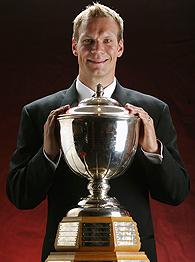
Mr. Norris -- I mean, Lidstrom
Lidstrom dominates now in a league that is filled with offensive-minded blue liners, and tough stay-at-home ones, too. No disrespect to Harvey, but when he played, there were perhaps 24-to-30 defensemen who played every night in the NHL. Lidstrom plays in a league where 180-to-200 defensemen play regularly. So is it more impressive to be first among 30, or first among 200?
Harvey dominated in his own way. Orr dominated in his own, revolutionary way. And now Lidstrom dominates, in his mechanical, robotic, perfect way.
The only thing Harvey and Orr have on Lidstrom, in my opinion, is more Norris Trophies to their credit. Soon, they won't even have that.
Harvey, the seven-time winner of the Norris Trophy as the NHL's best defenseman, played in the neanderthal days of the league, when the number of franchises was six and a "western swing" meant games in Chicago and Detroit.
I feel like I know of Harvey's skill set because of my late father, who would go on and on to me about the chubby blue liner who played mainly for Montreal.
"He'd get maybe one, two goals a year," my dad would say, always giving me the same litany about Harvey. I'd heard the case over and over -- but all was good. "He could block shots, defend in front of his net. He was just a good defenseman," he would go on, emphasizing the word as if to besmirch those who "claim" to play the position nowadays. There was nothing fancy or flashy about Doug Harvey, my dad would drill into me. He was just a good defenseman.
Today, Harvey is one of only two defensemen who have won more Norrises than the Red Wings' Nicklas Lidstrom, who picked up Norris No. 6 last night in Toronto. Harvey has seven; the all-time leader, someone named Robert Orr, has eight.
I've written in this space that Lidstrom is modern day sports' answer to the Tigers' Mechanical Man, all-world second baseman Charlie Gehringer, who owned the position in the 1930s. Plenty has been written about how Lidstrom is never out of position, and rarely gets burned, and always seems to make the right play, etc.
He's just a good defenseman. Of course, he can produce points, too -- something defensemen didn't start doing until the late-1960s. Thanks to one man, that all changed.
Orr thrilled us -- and yes, I DID see him play in his prime -- with his revolutionary method of defending, which was based on the theory that you can't score if I have the puck, and you can't beat us if we overpower you with our offense. No defenseman had come up with the end-to-end rush until Orr came along. And no defenseman had come close to leading the league in scoring, until Orr did that, too. But his knees betrayed him, or else Orr would have won maybe 10, 11 Norrises.
It's plenty likely that Lidstrom will catch and surpass Harvey, thus tying Orr. And it's not bad money if you'd like to wager it on Lidstrom, when all is said and done, surpassing both of them and standing alone as the most-winning Norris defenseman of all time.
Doug Harvey
Which begs the question -- and you probably saw this one coming paragraphs ago.
Is Nick Lidstrom the best defenseman ever?
Actually, you're too late; I've already asked this, and answered it. In that same rant about Lidstrom being mechanical, I came to my own conclusion: Yes, Nick Lidstrom will go down as the best defenseman to ever lace up an NHL skate.
But you haven't seen Doug Harvey!!
No, but even dear old dad might agree with me here. He died in 1996, in the middle of Lidstrom's sixth NHL season. Not long enough to fully appreciate how good No. 5 is now. I mean, we all knew Lidstrom was good back in '96, but you can't tell me that he hasn't gotten better in the 12 years hence. Lidstrom does the things that had my dad mesmerized by Harvey. The only thing Harvey might have on Lidstrom is the propensity to block shots with his body, but some of that is because the difference in eras. Besides, I haven't seen where Lidstrom's infrequency in this area has cost the Red Wings anything to speak of.
I'm not normally one to declare today's star athlete better than those of yore. I can be curmudgeonly that way, I admit. But I'm just not seeing where Lidstrom -- who I've seen from the get-go -- could possibly not be doing something that someone else did -- which would, in turn, make that someone else better than he is. Forget the shot-blocking thing. That's nitpicking, and you know it. Who else has played this game, night in and night out, with the same monotonous level of excellence as Nick Lidstrom has? I'm talking every night.
Don Cherry's favorite: Bobby Orr
Sometimes these post-season awards can be handed out based on reputation. Multiple winners, regardless of sport, aren't always worthy. That's something else you already know.
But being a six-time Norris winner isn't the same as being a six-time Pro Bowler. Not even close. Lidstrom wins the Norris every year, because every year he's the best defenseman the league has to offer. Simple as that. What's more, he wins it every year because no one else is even close to him; no one to even challenge him and maybe break his streak, if even to keep things mildly interesting. He's not only the best, he's far and away the best.
Orr dominated his position for a time, but mainly because he was a pioneer of sorts. No one else did, or could do, what Orr did when he sprang his offensive skills on an unsuspecting league. And Orr would occasionally leave his position vulnerable, being caught up ice more than once. Of course, before his knees went bad, he had the speed to compensate at times.
Mr. Norris -- I mean, Lidstrom
Lidstrom dominates now in a league that is filled with offensive-minded blue liners, and tough stay-at-home ones, too. No disrespect to Harvey, but when he played, there were perhaps 24-to-30 defensemen who played every night in the NHL. Lidstrom plays in a league where 180-to-200 defensemen play regularly. So is it more impressive to be first among 30, or first among 200?
Harvey dominated in his own way. Orr dominated in his own, revolutionary way. And now Lidstrom dominates, in his mechanical, robotic, perfect way.
The only thing Harvey and Orr have on Lidstrom, in my opinion, is more Norris Trophies to their credit. Soon, they won't even have that.
Friday, January 25, 2008
Lidstrom The Best Ever -- Even An Oldtimer Must Cede That
Once, there was Doug Harvey -- my dad's favorite, by the way -- who was a shot blocking maniac and so much of a stay-at-home defenseman that I wouldn't be surprised if he received his mail in front of the Red Wings' (and Canadiens') goal crease. There was also Bob Goldham, a pillar of the Red Wings' Cup-winning teams of the 1950s. Goldham would later become a Hockey Night In Canada analyst, talking about the current blueliners who were so inferior to him in his heyday.
Then along came Bobby Orr, and everything anyone knew about defensing in hockey went out the window, for Orr was a dazzling combination of skating, scoring, and playmaking -- from the "D" -- for the great Boston teams of the late-1960s, early-1970s. It's an overused term, but Orr truly revolutionized the way the position was played, and the way it was scouted.
Orr spawned the likes of Paul Coffey, Raymond Bourque, Al Iafrate, and others who would use speed and offense to, at times frankly, mask some of their defensive deficiencies.
Then there were the combos, like Al MacInnis, Chris Chelios, and Scott Stevens, who could do a little of both, but who had mostly a thick thread of nastiness in them.
Another defenseman exists today who is not revolutionizing the game. He's merely perfecting it.
I've written it before, and I'll write it again. You can have all of them -- Harvey, Goldham, Orr, Bourque, and the rest -- and I'll take Nick Lidstrom and trump you every time.
Sunday, Lidstrom will play in another All-Star game, and it's ironic, because though he is an annual participant, the game has never been about defense. But that's OK; his booming shot and precise passes go just fine there, too.
I'm usually an old fuddy-duddy when it comes to comparing players of different eras, which is always a futile endeavor anyway. But when it crops up, I'm likely to shove Oscar Robertson in front of you for every Michael Jordan reference, and Jimmy Brown for every Barry Sanders mentioning.
But I'm changing my tune with Lidstrom, who I'm convinced is playing defense better than anyone ever has in the National Hockey League. That's right -- EVER.
Here's Anaheim Ducks coach Randy Carlyle -- defending Cup champ coach and possessor of Chris Pronger and Scott Niedermayer on his team.
"What he's been able to accomplish and how he plays the game, he is (on) a different level," Carlyle was quoted in today's Free Press. "You can see it when he's out there, you can see the composure. You can see the things that he does. Nobody gives him enough credit for his defensive game."
Nobody except me, who is unashamedly putting Lidstrom at the top of the list as the best ever.
Carlyle spoke after the Red Wings' 2-1 win over the Ducks Wednesday night.
"He's playing against the best players in the league, and he's performing at the highest level. He defends extremely well with his stick."
That last sentence might be a candidate for biggest understatement in league history, too.

If a photo exists of Lidstrom being caught out of position, surely it's a fake -- a PhotoShop manipulation
Carlyle, who obviously couldn't help himself, went on.
"He's not a big guy, but his positional play is -- I don't know if there's a player that plays better in that position. (author's note: There isn't, Randy.) This guy is always up there and is always doing things that never seem to amaze people because, when you see him every day or you watch a lot of him, you kind of take it for granted. And that's what those elite players can do: They can make the most difficult task look easy."
When I wrote a similar heap of praise upon Lidstrom last season, I compared him to the Tigers' old second baseman, Charlie Gehringer, whose nickname was The Mechanical Man for his seemingly effortless way he would hit over .300 and play stellar defense. I suggested that Lidstrom was hockey's Mechanical Man, and Carlyle's comments are in line with that way of thinking.
But enough coachspeak. Listen to Lidstrom's contemporary, Pronger.
"If there's a lack of physical play [in Lidstrom's game], I certainly think he makes up for it by being in the right place at the right time. The way he can pass the puck and the way he sees the ice certainly makes him a special player and a guy who can control the tempo of a game. It takes a special player to be able to do that."
The Red Wings have had not only two of the game's greatest players, but also two of the most humble. In Lidstrom and Steve Yzerman, I don't know if you could drag a brilliant word about their own play out of them. The new captain is just as gracious and eloquent as his predecessor, conducting himself with the quiet grace that just adds more to his aura. They're both like Gordie Howe in that way.
Howe, the greatest right winger of all time -- and maybe the best player, too -- and Yzerman, one of the top five centermen ever, are now joined by Lidstrom, who I'd say became the best defenseman ever about a year or so ago.
This fuddy-duddy, whose memory of watching athletes perform dates back to 1970, is willing to concede that a modern day player is the best, all-time, at what he does. I don't do that very often. Usually, it kills me to even consider it.
But, as with everything else he does, Nick Lidstrom makes it easy.
Then along came Bobby Orr, and everything anyone knew about defensing in hockey went out the window, for Orr was a dazzling combination of skating, scoring, and playmaking -- from the "D" -- for the great Boston teams of the late-1960s, early-1970s. It's an overused term, but Orr truly revolutionized the way the position was played, and the way it was scouted.
Orr spawned the likes of Paul Coffey, Raymond Bourque, Al Iafrate, and others who would use speed and offense to, at times frankly, mask some of their defensive deficiencies.
Then there were the combos, like Al MacInnis, Chris Chelios, and Scott Stevens, who could do a little of both, but who had mostly a thick thread of nastiness in them.
Another defenseman exists today who is not revolutionizing the game. He's merely perfecting it.
I've written it before, and I'll write it again. You can have all of them -- Harvey, Goldham, Orr, Bourque, and the rest -- and I'll take Nick Lidstrom and trump you every time.
Sunday, Lidstrom will play in another All-Star game, and it's ironic, because though he is an annual participant, the game has never been about defense. But that's OK; his booming shot and precise passes go just fine there, too.
I'm usually an old fuddy-duddy when it comes to comparing players of different eras, which is always a futile endeavor anyway. But when it crops up, I'm likely to shove Oscar Robertson in front of you for every Michael Jordan reference, and Jimmy Brown for every Barry Sanders mentioning.
But I'm changing my tune with Lidstrom, who I'm convinced is playing defense better than anyone ever has in the National Hockey League. That's right -- EVER.
Here's Anaheim Ducks coach Randy Carlyle -- defending Cup champ coach and possessor of Chris Pronger and Scott Niedermayer on his team.
"What he's been able to accomplish and how he plays the game, he is (on) a different level," Carlyle was quoted in today's Free Press. "You can see it when he's out there, you can see the composure. You can see the things that he does. Nobody gives him enough credit for his defensive game."
Nobody except me, who is unashamedly putting Lidstrom at the top of the list as the best ever.
Carlyle spoke after the Red Wings' 2-1 win over the Ducks Wednesday night.
"He's playing against the best players in the league, and he's performing at the highest level. He defends extremely well with his stick."
That last sentence might be a candidate for biggest understatement in league history, too.
If a photo exists of Lidstrom being caught out of position, surely it's a fake -- a PhotoShop manipulation
Carlyle, who obviously couldn't help himself, went on.
"He's not a big guy, but his positional play is -- I don't know if there's a player that plays better in that position. (author's note: There isn't, Randy.) This guy is always up there and is always doing things that never seem to amaze people because, when you see him every day or you watch a lot of him, you kind of take it for granted. And that's what those elite players can do: They can make the most difficult task look easy."
When I wrote a similar heap of praise upon Lidstrom last season, I compared him to the Tigers' old second baseman, Charlie Gehringer, whose nickname was The Mechanical Man for his seemingly effortless way he would hit over .300 and play stellar defense. I suggested that Lidstrom was hockey's Mechanical Man, and Carlyle's comments are in line with that way of thinking.
But enough coachspeak. Listen to Lidstrom's contemporary, Pronger.
"If there's a lack of physical play [in Lidstrom's game], I certainly think he makes up for it by being in the right place at the right time. The way he can pass the puck and the way he sees the ice certainly makes him a special player and a guy who can control the tempo of a game. It takes a special player to be able to do that."
The Red Wings have had not only two of the game's greatest players, but also two of the most humble. In Lidstrom and Steve Yzerman, I don't know if you could drag a brilliant word about their own play out of them. The new captain is just as gracious and eloquent as his predecessor, conducting himself with the quiet grace that just adds more to his aura. They're both like Gordie Howe in that way.
Howe, the greatest right winger of all time -- and maybe the best player, too -- and Yzerman, one of the top five centermen ever, are now joined by Lidstrom, who I'd say became the best defenseman ever about a year or so ago.
This fuddy-duddy, whose memory of watching athletes perform dates back to 1970, is willing to concede that a modern day player is the best, all-time, at what he does. I don't do that very often. Usually, it kills me to even consider it.
But, as with everything else he does, Nick Lidstrom makes it easy.
Subscribe to:
Posts (Atom)